Find the Best Yard Drainage Contractors for Your Business
No obligation • Fast responses • Nationwide coverage

Why you can trust Landscape Atlas
Landscape Atlas is a leading United States resource for evaluating landscaping, lawn care, and outdoor service providers. Our team researches each category in depth, focusing on service quality, safety, and customer experience. Listings and rankings are based on independent criteria and user feedback, and companies cannot pay to influence our assessments or recommendations.
Search providers near you
Top Yard Drainage Contractors in Pittsburgh, Pennsylvania Ranked
A soggy lawn, a flooded basement, or persistent erosion can turn your Pittsburgh property from an asset into a headache. Effective yard drainage and grading are essential services that manage water flow to protect your home's foundation, preserve your landscape, and create a usable outdoor space. This guide will help you understand the common solutions for water management in our region, from simple grading adjustments to complex drainage systems, so you can identify the right approach and connect with skilled local professionals to solve your property's unique challenges.
A&J Lawn Pros LLC
Pittsburgh, PA
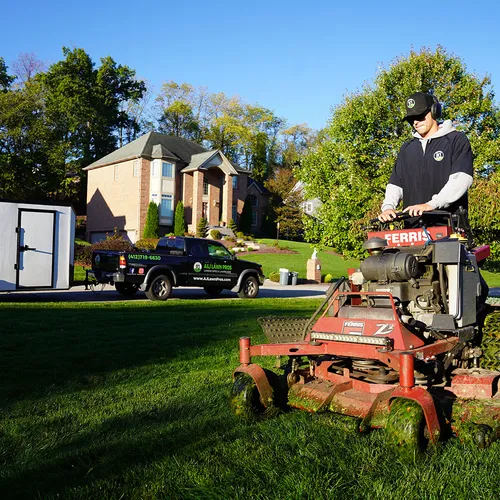
A&J Lawn Pros LLC is a landscaping and lawn care company based in Pittsburgh, PA. They offer a wide range of outdoor services including lawn mowing, fertilization, weed control, landscape design, hardscaping with patios and retaining walls, yard drainage, land clearing, and holiday lighting installation. Their team also handles commercial and residential property maintenance, excavation, and grading projects. The company is licensed and insured, emphasizing safety and professionalism in their work. They provide personalized consultations and use commercial-grade equipment to maintain lawns and outdoor spaces.
Dream Greener Lawn & Landscape
4991 Library Rd, Bethel Park, PA 15102
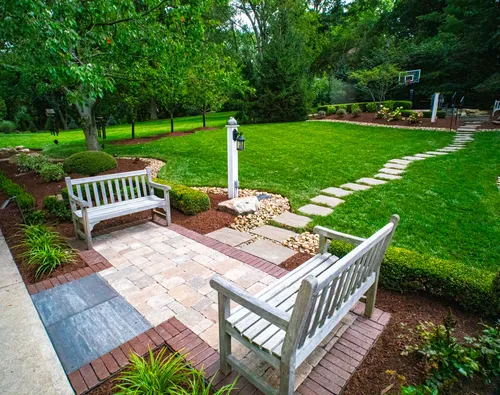
Dream Greener Lawn & Landscape is a comprehensive lawn care and landscaping company serving Pittsburgh, PA, and nearby communities. They offer a wide range of services including lawn fertilization, weed control, sod installation, landscape lighting, tree services, yard drainage, hardscaping, and landscape design. The company operates with a science-based approach to lawn and plant health, supported by their own plant nursery and materials stock, which helps ensure quality and timely project completion. Founded in 2013 by Jon Stanton, a nationally recognized turf specialist, Dream Greener Lawn & Landscape combines expert knowledge with advanced technology to provide personalized and environmentally conscious outdoor solutions. Their team includes certified arborists and licensed technicians, and they emphasize ongoing monitoring and integrated pest management to maintain healthy landscapes.
Jared Johnston Landscaping
329 Mt Nebo Rd, Pittsburgh, PA 15237
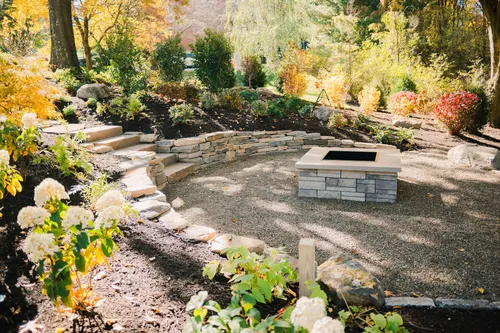
Jared Johnston Landscaping is a landscaping and outdoor living company based in Pittsburgh, PA. They specialize in landscape design, installation, hardscaping, yard drainage, and outdoor lighting, serving the Northern Pittsburgh area including Cranberry Township, Warrendale, Sewickley, Franklin Park, Wexford, and Gibsonia. The company offers custom landscape designs that blend softscaping and hardscaping to enhance home exteriors with features such as retaining walls, water features, and exterior lighting. They use 2D and 3D rendering software to help clients visualize their projects before installation. Jared Johnston Landscaping combines the efficiency of a larger firm with a family-owned business approach to deliver detailed craftsmanship and environmentally sustainable solutions.
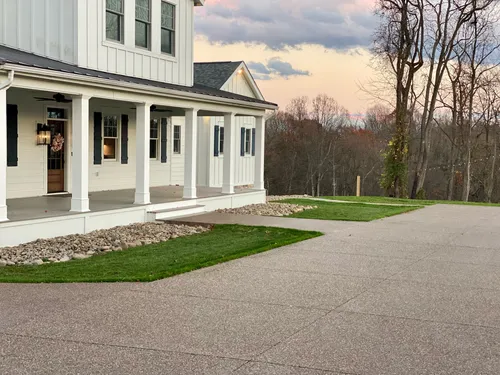
South Hills Landscaping & Excavating, Inc.
400 Castleview Rd, Pittsburgh, PA 15234
South Hills Landscaping & Excavating, Inc. is a landscape design and hardscaping company based in Pittsburgh, PA. They offer a wide range of services including custom concrete work, retaining walls, outdoor kitchens, excavation, grading, drainage systems, landscaping, light forestry, and commercial maintenance. With over 25 years of experience, their team handles projects from design to construction, including demolition and waterproofing solutions. The family-run business emphasizes quality workmanship and dependable service to enhance outdoor living spaces.
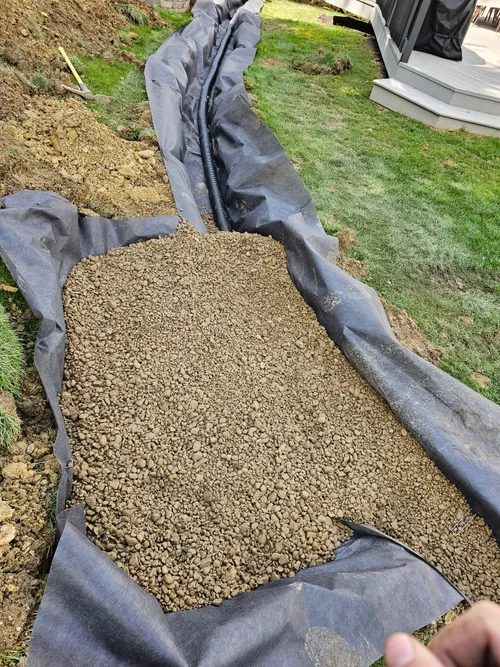
Mr. French Drain
1 Phillips Ln, McKees Rocks, PA 15136
Mr. French Drain is a family-owned drainage and waterproofing contractor based near Pittsburgh, PA. With over 15 years of experience, they provide services including French drain installation, foundation waterproofing, foundation repair, and stormwater management to protect properties from water damage. Their licensed and ADS-certified team serves Pittsburgh and surrounding Pennsylvania communities, focusing on preventing leaks, flooding, and foundation issues.
Living in Pittsburgh means dealing with a mix of steep hills, clay-heavy soils, and significant rainfall, all of which can conspire to create serious water issues on your property. Proper land grading and water management are not just about a dry lawn; they are critical for preventing foundation cracks, mold growth, and landscape destruction. The core principle is simple: move water away from your home and to a place where it can be safely absorbed or discharged. This often requires creating a deliberate slope, known as a grade, and sometimes installing subsurface systems to handle excess groundwater.
Common Drainage and Grading Problems in Pittsburgh
Before exploring solutions, it's important to diagnose the problem. Pittsburgh homeowners often face:
- Standing Water: Puddles that linger for days after rain, killing grass and attracting mosquitoes.
- Basement Seepage: Water finding its way into your basement or crawl space, often due to poor lot grading directing water toward the foundation.
- Soil Erosion: Washouts along hillsides or beneath downspouts where fast-moving water carries away topsoil.
- Soggy Lawn: Areas that are perpetually soft and muddy, making the yard unusable and damaging plant roots.
- Ice Patches: In winter, poor drainage leads to dangerous sheets of ice on walkways and driveways.
Core Solutions for Yard Water Management
Professional drainage contractors and grading specialists in Pittsburgh utilize a toolkit of proven methods. The right solution depends on your property's slope, soil type, and the water source.
1. Regrading and Lawn Leveling
This is often the first line of defense. Yard grading involves reshaping the soil's contour to create a slope that directs surface water away from your home. The standard recommendation is a drop of at least 6 inches for every 10 feet of horizontal distance away from the foundation 1. This process can involve adding clean topsoil to build up low areas or carefully cutting away soil to establish a new slope. For larger properties or significant corrections, professionals use laser-guided equipment to ensure precise, effective grading that promotes proper surface drainage.
2. Subsurface Drainage Systems
When surface grading isn't enough, or where groundwater is the issue, underground systems are installed.
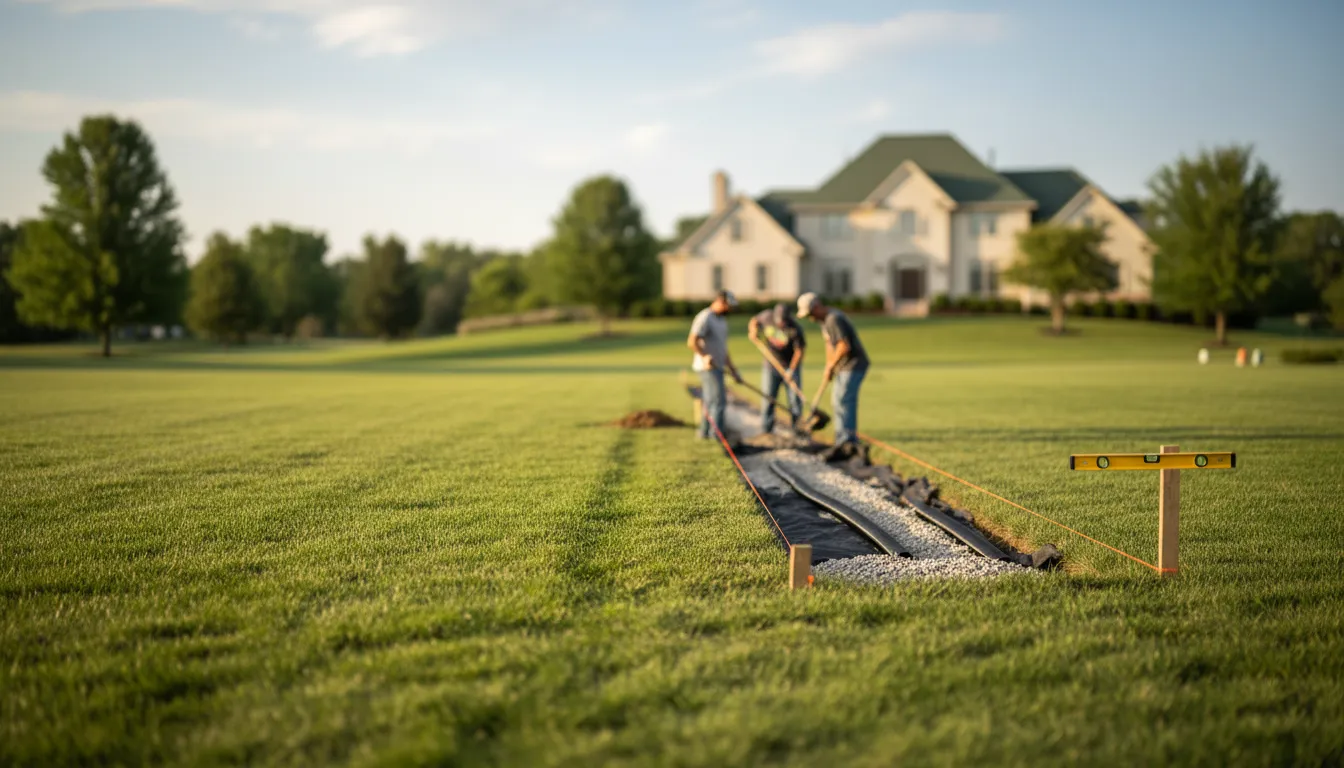
- French Drains: A trench is dug, lined with filter fabric, and filled with gravel and a perforated pipe. This system collects water from saturated soil and channels it away to a storm drain, dry well, or lower area of the yard. Costs for a professionally installed French drain in Pittsburgh can range from $20 to $60 or more per linear foot, depending on depth and complexity.
- Channel Drains (Catch Basins): These are ideal for collecting large volumes of surface water from driveways, patios, or low spots. A grated basin is set into the ground, connected to a solid pipe that carries the water away.
- Dry Wells: An underground chamber filled with gravel that collects diverted water from downspouts or drains and allows it to slowly percolate back into the surrounding soil.
3. Complementary Surface Solutions
These work in tandem with grading and subsurface systems.
- Swales: These are wide, shallow, vegetated ditches designed to gently guide water across a property to a safe discharge point. They are a more natural-looking alternative to concrete channels.
- Downspout Extensions and Splash Blocks: A simple but critical fix. Extending your downspouts to discharge roof water at least 5 feet away from your foundation prevents concentrated water from pooling at your home's base.
- Rain Gardens: A landscaped depression planted with water-tolerant native plants. It collects runoff from roofs or driveways, allowing it to be filtered and absorbed naturally, reducing the burden on other drainage systems.
Find the perfect yard drainage contractors for your needs
Get personalized recommendations and expert advice
The Professional Installation Process
Understanding the steps a professional will take can help you know what to expect when you hire a site grading or drainage installation expert.
- Site Evaluation and Diagnosis: A thorough inspection identifies the source of water (e.g., roof runoff, hillside springs, neighbor's property), the type of soil, and the natural slope of your land. This step is crucial for designing an effective solution.
- Solution Design and Planning: Based on the evaluation, the contractor will recommend a plan. This may involve a single method or a combination (e.g., regrading the lawn and installing a French drain along a problematic side yard). The plan will identify where water will be safely directed2.
- Implementation:
- For grading projects, this involves moving soil, compacting it to prevent future settling, and finely grading the surface for seeding or sodding.
- For drainage installations, this includes trenching, laying pipe, installing basins, filling with gravel, wrapping in fabric to prevent clogging, and connecting all components 3.
- Testing and Final Restoration: The system is tested with water to ensure proper flow. Trenches are backfilled, and the site is restored with topsoil, seed, sod, or mulch to blend with the existing landscape.
Cost Considerations for Pittsburgh Homeowners
The investment for residential drainage solutions varies widely, as it is highly dependent on the scope of the problem and the property's characteristics.
- Minor Corrections: Installing splash blocks or downspout extensions is a relatively low-cost fix, often in the $50 to $200 range for materials and labor.
- Lawn Regrading: Adding topsoil and reshaping a moderate-sized yard can range from $200 for a simple DIY material cost to $1,000 or more for professional grading with equipment4 5.
- Drainage System Installation: As noted, French drains typically cost $20-$60+ per linear foot installed. A single catch basin installation can range from $300 to $800 6.
- Comprehensive Systems: For complex issues requiring a full yard drainage redesign-combining regrading, multiple French drains, and catch basins-homeowners should budget between $1,000 and $5,000 or more7 8.
It's important to view these costs as an investment in protecting your home's structural integrity and your property's value. Ignoring water problems often leads to far more expensive repairs down the line.
Maintaining Your Drainage System
Once installed, proper maintenance ensures your system works for years to come.
- Keep gutters and downspouts clear of leaves and debris.
- Inspect and clean the grates of any catch basins regularly.
- Avoid driving or placing heavy objects over areas where drainage pipes are buried.
- Periodically check the outlets of French drains or discharge pipes to ensure they are not blocked.
- After heavy rains, walk your property to ensure water is flowing as intended and not creating new erosion patterns.
Taking a proactive approach to yard grading and drainage in Pittsburgh is key to enjoying a dry, stable, and beautiful property. By understanding the solutions available, you can have an informed conversation with a local specialist and develop a plan that brings lasting peace of mind.
Frequently asked questions
Sources
Footnotes
-
2021 International Residential Code (IRC) - R401.3 Drainage. - https://codes.iccsafe.org/s/IRC2021P3/chapter-4-foundations/IRC2021P3-Pt03-Ch04-SecR401.3 ↩
-
Grading & Drainage - Donas Outdoor Living - https://donasoutdoorliving.com/grading-drainage/ ↩
-
7 Ways to Improve Drainage in Your Yard - LawnStarter - https://www.lawnstarter.com/blog/landscaping/improve-drainage-in-your-yard/ ↩
-
Lawn Grading | Pittsburgh, PA - https://www.adlertreeservice.net/lawn-grading ↩
-
Yard Grading 101: Everything you need to know - This Old House - https://www.thisoldhouse.com/lawns/yard-grading ↩
-
Essential Yard Drainage Systems to Protect Your Landscape - https://hydroscapespa.com/top-yard-drainage-systems/ ↩
-
Control Heavy Runoff - Solving Drainage and Erosion Problems - https://www.fairfaxcounty.gov/soil-water-conservation/drainage-problem-control-runoff ↩
-
How to Solve Yard Drainage Problems | Lowe's - https://www.lowes.com/n/how-to/solve-simple-drainage-problems ↩