Find the Best Yard Drainage Contractors for Your Business
No obligation • Fast responses • Nationwide coverage

Why you can trust Landscape Atlas
Landscape Atlas is a leading United States resource for evaluating landscaping, lawn care, and outdoor service providers. Our team researches each category in depth, focusing on service quality, safety, and customer experience. Listings and rankings are based on independent criteria and user feedback, and companies cannot pay to influence our assessments or recommendations.
Search providers near you
Top Yard Drainage Contractors in Vancouver, Washington Ranked
A soggy lawn, a perpetually flooded patio, or water pooling against your home's foundation are more than just annoyances-they are signs of a yard drainage problem that can threaten your property's structural integrity and landscape health. Proper yard drainage and grading involves shaping the land and installing systems to manage surface and subsurface water, directing it safely away from structures and into appropriate areas. For homeowners in Vancouver, WA, where seasonal rains and specific soil conditions can exacerbate water issues, finding effective solutions is crucial. This guide explains the core concepts, local considerations, and available solutions to help you connect with the right expertise to protect your investment.
HD Landscape and Maintenance
Portland, OR
HD Landscape and Maintenance is a landscaping and maintenance company serving Portland, OR, and the surrounding metropolitan area. They offer a wide range of services including lawn care, sod and artificial turf installation, fence installation, landscape lighting, landscape design, tree services, yard drainage, hardscaping, and seasonal maintenance. Their work covers residential and commercial properties across Multnomah, Washington, and Clackamas counties. The company emphasizes sustainable landscaping practices using native plants and eco-friendly materials. They are fully licensed and insured, with experience handling projects from initial design to completion, including specialized capabilities like storm damage restoration and smart drainage systems.
Simple Lawns Landscape Design
9707 NE 54th St #C, Vancouver, WA 98662
Simple Lawns Landscape Design is a family-owned landscaping and lawn care company serving Portland, OR. They provide a full range of services including lawn mowing, fertilization, weed control, landscape design, yard drainage, sprinkler installation and repair, and hardscaping such as pavers and retaining walls. With over 20 years of experience, they focus on durable outdoor solutions backed by a 5-year warranty on hardscaping. Their team includes trained installers who stay current with landscaping techniques to ensure quality results.
Lawn & Irrigation Technologies NW
2900 SE Cornelius Pass Rd Ste 336, Hillsboro, OR 97123
Lawn & Irrigation Technologies NW is a landscaping and irrigation contractor based in Portland, OR, serving the Washington County area for over 30 years. They offer a wide range of services including irrigation system installation and repair, sod installation, landscape lighting, paver installation, yard drainage solutions, and lawn fertilization. Their team is known for using water-efficient irrigation products and providing NDS-certified drainage solutions to enhance outdoor spaces while promoting environmental stewardship.
Danshap Landscaping and Excavation inc.
7800 NE 103rd Ave, Vancouver, WA 98662
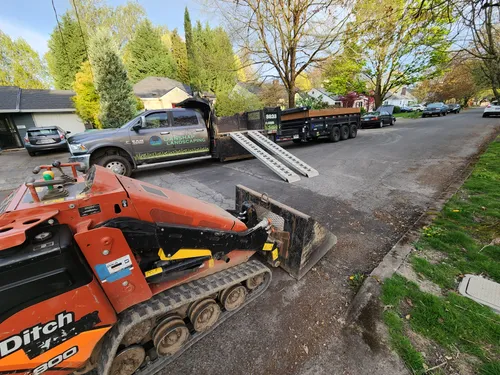
Danshap Landscaping and Excavation Inc. is a licensed, bonded, and insured landscaping company serving Portland, OR, and the surrounding areas. They offer a wide range of services including sod installation, landscape design, tree removal, stump grinding, yard drainage, grading, land clearing, brush removal, and general lawn care. The company is equipped to handle both residential and commercial projects, with capabilities such as grading and re-sloping yards to improve drainage and appearance. Danshap Landscaping is locally owned and operated, with a strong focus on customer satisfaction and quality workmanship.
Wyeast Gardens, LLC
23202 SE Hoffmeister Rd, Damascus, OR 97089
Wyeast Gardens, LLC is a full-service landscaping company based in Portland, OR, offering landscape design, irrigation installation and repair, yard drainage solutions, and hardscaping services. Serving commercial, residential, industrial, and governmental clients, they specialize in efficient irrigation systems and sustainable water management to enhance outdoor spaces. Established in 1994, Wyeast Gardens brings over 25 years of experience, including work with national cemeteries and VA hospitals, and provides skilled masonry and landscape construction services.
Understanding Yard Drainage Problems in Vancouver
Vancouver's climate, with its wet winters and springs, makes effective water management a priority for any property. Common issues include standing water that kills grass, creates mud pits, or breeds mosquitoes. More seriously, hydrostatic pressure from saturated soil can lead to basement leaks, cracked foundations, and damaged retaining walls. The region's soil composition, often containing clay, can be slow to absorb water, leading to increased surface runoff. Recognizing these problems early is the first step toward a drier, healthier yard.
Core Principles: Grading and Drainage Systems
Solving water issues typically involves a combination of regrading the land's surface and installing subsurface drainage systems. These two approaches work hand-in-hand to control the flow of water across and through your property.
Landscape Grading: The First Line of Defense
Grading is the process of shaping the soil to create a gentle, consistent slope. The primary goal is to establish a "positive grade"-meaning the ground slopes away from your home's foundation at a minimum rate of 2% (about 1/4 inch per foot) 1 2. Proper yard grading prevents surface water from flowing toward your house, instead guiding it toward a street gutter, a drainage ditch, or a designated safe zone in your landscape.
- Regrading Process: This often involves bringing in fill dirt or topsoil, compacting it, and carefully sculpting the final grade. For severe issues, machinery may be needed to move significant amounts of earth.
- Final Touches: After grading, the area is typically restored with sod or grass seed to prevent erosion and integrate the new grade into your lawn.
Subsurface Drainage Solutions
When grading alone isn't enough, or when dealing with underground water (a high water table or spring), various drainage systems are installed beneath the surface.
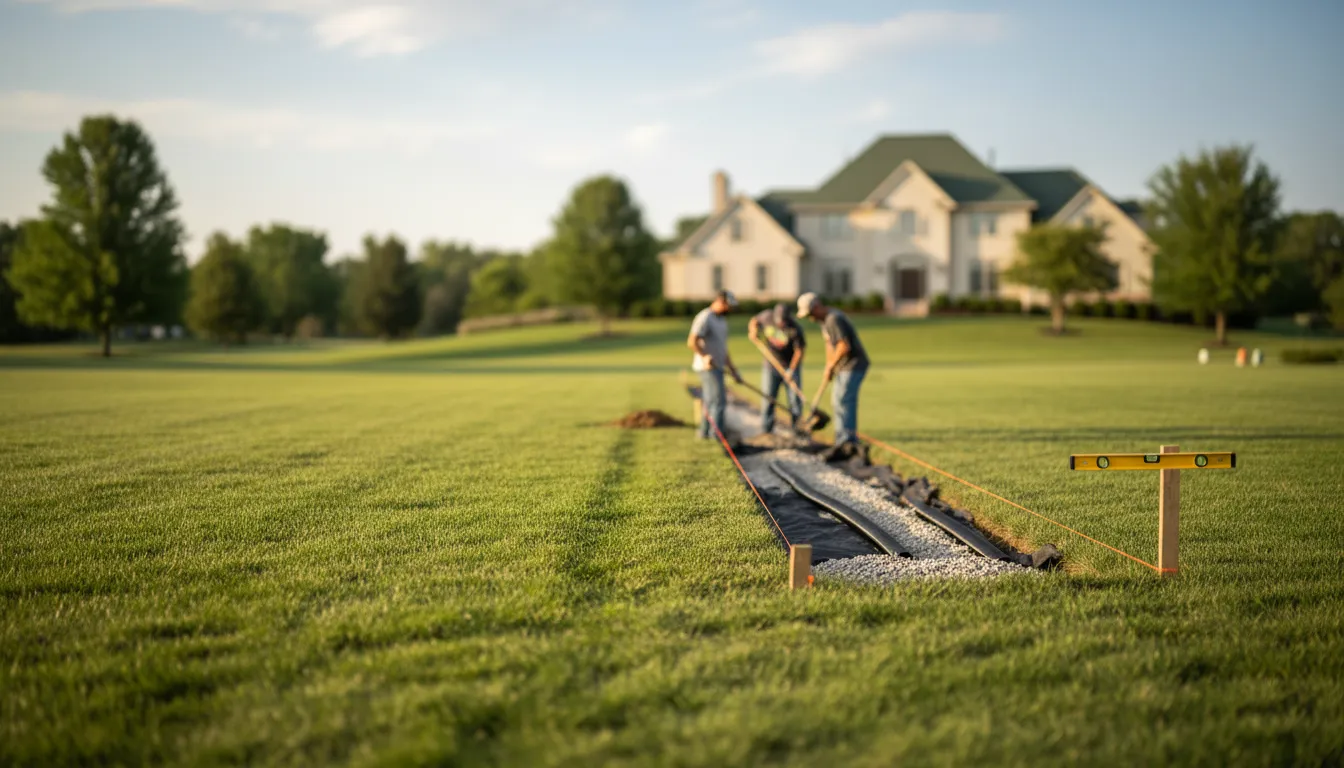
- French Drains: A classic and highly effective solution. A French drain involves digging a trench, lining it with landscape fabric, adding a bed of gravel, laying a perforated pipe, and then covering it with more gravel. This system collects groundwater and redirects it to a safe discharge point, like a storm drain or a dry well.
- Catch Basins and Trench Drains: These are designed for capturing surface water. A catch basin is a buried container with a grate at ground level placed in a low spot. It collects pooling water and connects to a solid pipe that carries it away. Trench drains are long, linear grates often used across driveways or walkways to intercept flowing water 3.
- Dry Wells: A dry well is an underground chamber filled with gravel or a prefabricated vault that collects water from downspouts or drainage pipes and allows it to slowly percolate into the surrounding soil. This is an excellent solution when there's no convenient place to daylight a drain pipe.
- Downspout Management: Often the simplest fix is extending downspouts well away from the foundation (at least 5-10 feet) using splash blocks or buried solid pipes.
Advanced and Eco-Friendly Drainage Options
For properties with specific challenges or homeowners interested in sustainable landscaping, several integrated solutions exist.
- Rain Gardens and Bioswales: These are landscaped depressions designed to capture, filter, and slowly absorb stormwater runoff. Planted with native, water-tolerant plants, a rain garden beautifies your yard while reducing runoff and filtering pollutants. A bioswale is a similar but often longer, channel-like feature that slows and treats water as it flows.
- Retaining Walls with Drainage: On sloped properties, retaining walls are necessary for creating usable flat spaces. Crucially, these walls must include proper drainage behind them, typically involving gravel backfill and a perforated "weep" pipe at the base to relieve water pressure that could cause the wall to fail 4.
Find the perfect yard drainage contractors for your needs
Get personalized recommendations and expert advice
The Professional Process: From Assessment to Restoration
Tackling a significant drainage project is a multi-step process best handled by experienced professionals familiar with Vancouver's codes and conditions.
- Site Assessment and Diagnosis: A specialist will inspect your property during or after a rain to identify problem areas, trace water flow paths, and assess soil conditions. They will also check the existing grade around your foundation.
- System Design and Planning: Based on the assessment, a plan is created. This includes determining the optimal type and placement of drains, calculating the necessary slope for pipes, and identifying a legal and practical outlet for the water.
- Permitting: In Vancouver, significant grading work or installing drainage that connects to the public storm system may require a permit from the City of Vancouver. A reputable contractor will handle this process, ensuring compliance with local regulations like the International Residential Code (IRC) and city stormwater standards.
- Excavation and Installation: This is the construction phase. Trenches are dug for drains, soil is moved for grading, and all system components (pipes, basins, fabric, gravel) are installed according to the design.
- Restoration and Erosion Control: Finally, all disturbed areas are backfilled, covered with topsoil, and restored with sod, seed, or mulch. Proper restoration is key to preventing new erosion problems and making your yard look finished 5.
Cost Considerations for Drainage Work in Vancouver, WA
The investment for yard drainage solutions varies widely based on the complexity of the problem, the size of your property, the solutions chosen, and local labor and material rates. Here is a general overview of potential cost ranges:
- Simple Regrading/Adding Topsoil: For correcting minor slope issues, costs can range from a few hundred to over a thousand dollars, depending on the area.
- French Drain Installation: As a common and involved solution, installing a French drain system typically costs between $1,000 and $3,000 or more per run, factoring in trenching, materials, and labor 6.
- Catch Basin or Dry Well: Installing a single catch basin or a basic dry well can range from $500 to $1,500+ 7.
- Retaining Wall with Drainage: Walls are a significant project. A professionally installed retaining wall that includes necessary drainage features can range from $3,500 to over $9,000 depending on materials (e.g., timber, segmental block, poured concrete) and size.
- Final Restoration: Sodding a graded area typically costs $1-$2 per square foot, while hydroseeding a larger area might range from $500 to $3,000 8.
Important Note: These are estimates. The most accurate way to understand the cost for your specific situation is to obtain detailed quotes from licensed and insured local contractors who specialize in drainage and grading 9 10.
Local Vancouver Resources and Regulations
Before starting any project, it's wise to understand the local context. The City of Vancouver has guidelines for private stormwater facilities and may require permits for work that alters drainage patterns or could impact public systems 11. Clark County WSU Extension also provides valuable resources on improving drainage for small acreages, which include principles applicable to residential properties 12. Working with a local professional ensures your project meets these standards.
Frequently asked questions
Sources
Footnotes
-
Yard Grading 101: Everything you need to know - This Old House - https://www.thisoldhouse.com/lawns/yard-grading ↩
-
2021 International Residential Code (IRC) - R401.3 Drainage. - https://codes.iccsafe.org/s/IRC2021P3/chapter-4-foundations/IRC2021P3-Pt03-Ch04-SecR401.3 ↩
-
Control Heavy Runoff - Solving Drainage and Erosion Problems - https://www.fairfaxcounty.gov/soil-water-conservation/drainage-problem-control-runoff ↩
-
Sloped Yard Drainage: 12 Best DIY Solutions for 2024 - https://salcorplandscaping.com/sloped-yard-drainage/ ↩
-
How to Solve Yard Drainage Problems | Lowe's - https://www.lowes.com/n/how-to/solve-simple-drainage-problems ↩
-
French Drains and Other Yard Drainage in Vancouver, WA - https://wearegro.com/blog/french-drains-and-other-yard-drainage-in-vancouver-wa/ ↩
-
10 Drainage Solutions for Your Yard - This Old House - https://www.thisoldhouse.com/lawns/lawn-drainage-solutions ↩
-
Landscape Grading and Drainage Costs - https://www.whiteshovel.com/blog/landscape-grading-and-drainage-costs ↩
-
Commercial & Residential Drainage Contractors | Vancouver ... - https://www.drainagemasters.com/service-area/vancouver-washington/ ↩
-
Irrigation & Drainage Solutions in Vancouver, WA - https://namslandscaping.com/services/irrigation-drainage-solutions/ ↩
-
Private Stormwater Facilities -The City of Vancouver, WA - https://www.cityofvancouver.us/government/department/public-works/water-sewer-and-stormwater/private-stormwater-facilities/ ↩
-
Improving Drainage | Clark County | Washington State University - https://extension.wsu.edu/clark/naturalresources/smallacreageprogram/improving-drainage/ ↩