Find the Best Yard Drainage Contractors for Your Business
No obligation • Fast responses • Nationwide coverage

Why you can trust Landscape Atlas
Landscape Atlas is a leading United States resource for evaluating landscaping, lawn care, and outdoor service providers. Our team researches each category in depth, focusing on service quality, safety, and customer experience. Listings and rankings are based on independent criteria and user feedback, and companies cannot pay to influence our assessments or recommendations.
Search providers near you
Top Yard Drainage Contractors in Hemet, California Ranked
Proper yard drainage and grading are essential for protecting your Hemet home from water damage. Without a well-designed system, seasonal rains can lead to soggy lawns, foundation issues, and costly repairs. This guide explains the key solutions for managing water on your property and how to connect with local professionals who can assess your needs and implement an effective plan.
Greenwood hardscape
Riverside, CA
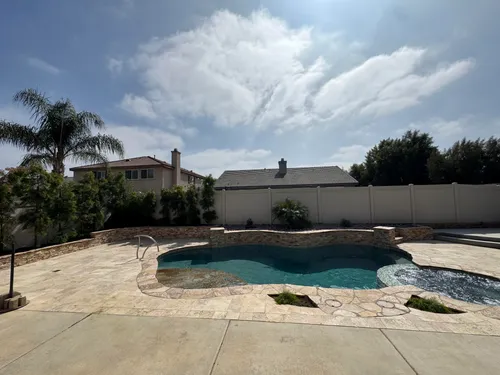
Greenwood Hardscape is a landscaping and hardscaping contractor based in Riverside, CA. They specialize in yard drainage, grading, pavers, retaining walls, and site preparation, combining modern innovation with timeless design to create personalized outdoor spaces. The company serves multiple locations across Southern California, including Moreno Valley, Temecula, and Corona. Greenwood Hardscape emphasizes craftsmanship and integrity in every project, offering services such as excavation and turf installation to enhance both the beauty and functionality of properties.
LawnStarter Lawn Care Service
4580 Belford Way, Riverside, CA 92507
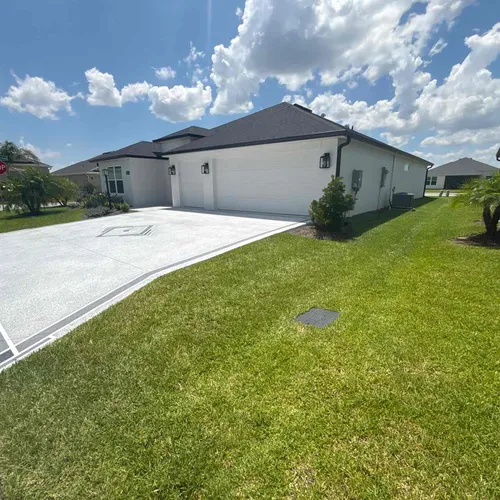
LawnStarter Lawn Care Service provides a wide range of lawn care and landscaping services in Riverside, CA. Their offerings include lawn mowing, fertilization, weed control, tree removal, stump grinding, yard drainage, sprinkler installation and repair, and general landscaping. They emphasize convenience with online booking and account management, backed by insured professionals. LawnStarter also offers specialized services such as gutter cleaning and yard cleanup. The company serves various neighborhoods within Riverside and supports customers with a mobile app for easy service management.
Advanced Drainage Systems, Inc.
4982 Patterson Ave, Perris, CA 92571
Advanced Drainage Systems, Inc. provides yard drainage and grading services in Riverside, CA. The company specializes in stormwater management solutions, including durable pipe systems and water management products such as chambers and basins. With a focus on sustainability, Advanced Drainage Systems operates one of the most advanced stormwater engineering centers and has been recognized for its environmental and social governance efforts. Their solutions are designed to manage water effectively from rainfall through to safe environmental return, addressing both everyday and severe weather challenges.
Christian Meyer Landscape
Riverside, CA
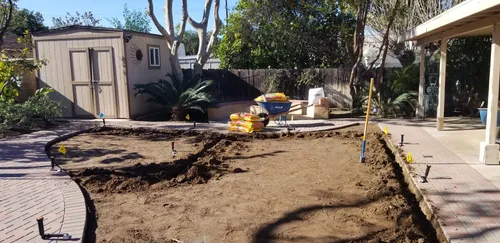
Christian Meyer Landscape is a landscaping design and installation contractor based in Riverside, CA. They offer a wide range of services including landscape design, outdoor living spaces, fire pit and fireplace installation, irrigation system installation and repair, artificial grass installation, fencing, drainage, and hardscaping such as pavers and flagstone patios. With over 15 years of combined experience, they also provide construction management to ensure projects meet specifications and are completed on time. Their team is available seven days a week to assist with landscaping projects and related services.
MGN Landscaping & Sprinkler Repair - Moreno Valley
Riverside, CA
MGN Landscaping & Sprinkler Repair - Moreno Valley provides comprehensive landscaping and sprinkler services in Riverside, CA. They offer a range of services including sprinkler repair, sod and artificial turf installation, fence and gate installation, landscape lighting, yard drainage, hardscaping with pavers and retaining walls, and complete backyard renovations. The company serves Riverside as well as Los Angeles and Orange Counties, handling projects of various sizes with a focus on professionalism and respect for customers' time. MGN Landscaping & Sprinkler Repair is licensed and insured, with expertise in sprinkler system repairs and rerouting, as well as landscape design and installation.
Why Effective Drainage is Critical in Hemet
The semi-arid climate of Hemet means that when rain does arrive, it can be intense. The soil composition in the area may not always absorb water quickly, leading to surface runoff and pooling. Inadequate drainage can cause water to seep toward your home's foundation, creating hydrostatic pressure that leads to cracks, leaks, and mold. Beyond structural threats, standing water creates mosquito breeding grounds and can kill grass, plants, and trees. Implementing proper land grading and water management systems is not just about lawn care; it's a vital investment in your property's longevity and safety.
Core Solutions for Water Management
A comprehensive approach to yard drainage often combines several techniques tailored to your property's specific challenges. Here are the primary methods used by landscape and grading contractors.
Regrading for Positive Slope
The first line of defense is ensuring your yard has a positive grade. This means the land is sloped away from your home's foundation at a minimum decline, typically 2% over the first 10 feet. Regrading involves moving and compacting soil to create this crucial slope, directing surface water to flow safely away from structures 1. It's often the most fundamental and cost-effective correction for minor pooling issues.
Subsurface Drainage: French Drains
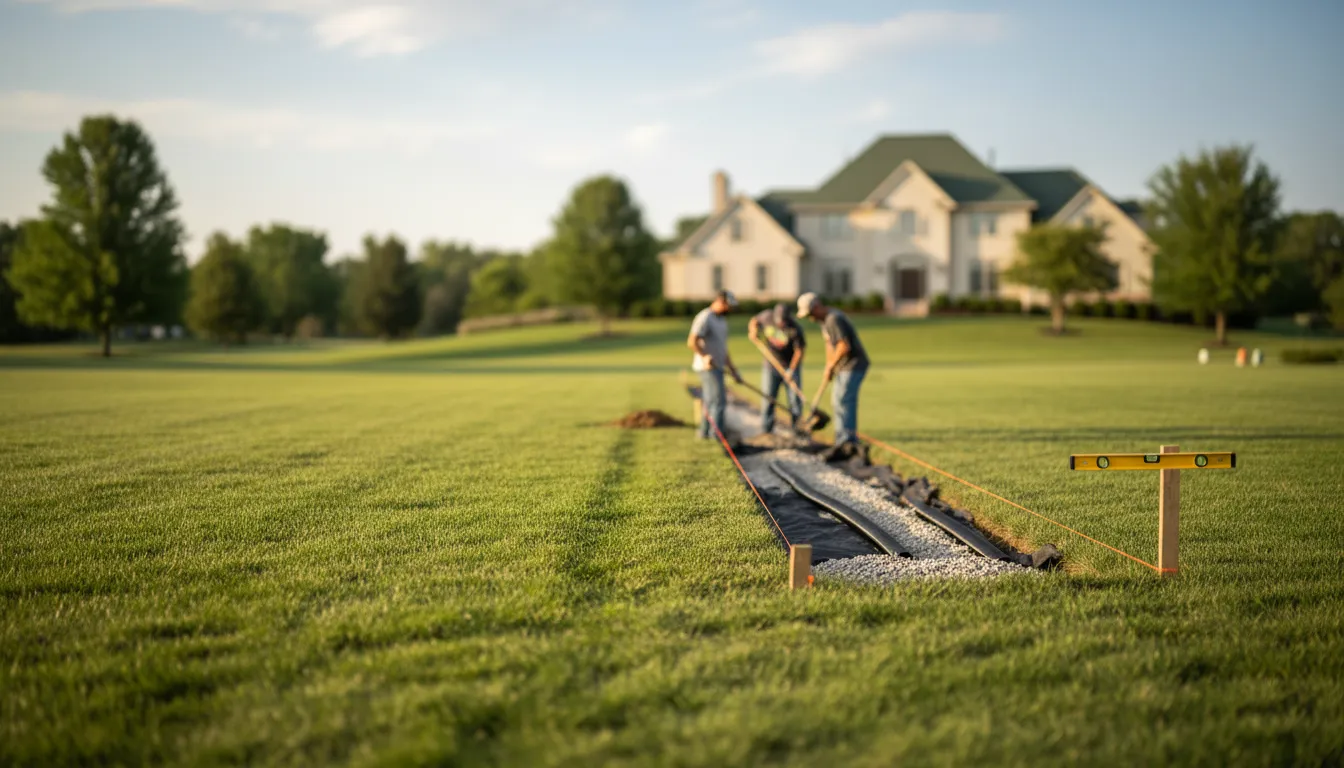
For areas where water saturates the soil or collects in low spots, a French drain is a common solution. This involves digging a trench, laying a perforated pipe wrapped in fabric, and filling it with gravel. The system collects groundwater and redirects it to a safer discharge point, like a dry well or street gutter. They are particularly effective for solving soggy yard problems and relieving hydrostatic pressure against foundation walls.
Surface Water Collection: Catch Basins and Channel Drains
To handle water from hard surfaces like driveways, patios, or walkways, surface drains are installed. Catch basins are installed in low points with a grate at ground level to collect runoff, connecting to an underground pipe. Channel drains are long, narrow grates ideal for across driveways or along garage entries. These components are key for preventing erosion and flooding on paved areas.
Stormwater Storage: Dry Wells
When redirecting water to the street isn't feasible or allowed, a dry well provides an alternative. This is an underground chamber filled with gravel or a pre-fabricated tank that collects water from downspouts or drainage pipes. The water slowly percolates into the surrounding subsoil over time, preventing overwhelming the municipal system or creating runoff on your property.
Downspout and Gutter Integration
A complete drainage plan always addresses roof runoff. Simply extending downspouts several feet from the house is a good start, but for a more permanent and tidy solution, downspouts can be connected to underground drain pipes that tie into the main drainage system or direct water to a dry well.
Find the perfect yard drainage contractors for your needs
Get personalized recommendations and expert advice
The Professional Installation Process
Understanding the steps involved can help you know what to expect when you hire a contractor for drainage work in Hemet.
- Site Assessment and Problem Identification: A professional will inspect your property during or after a rain to identify pooling areas, evaluate soil type, check the existing grade, and look for signs of foundation water intrusion.
- System Design and Planning: Based on the assessment, the contractor will design a system that may combine grading, French drains, catch basins, and other components. They will determine the optimal paths for water flow and locate discharge points.
- Permitting: The City of Hemet has drainage policies to ensure stormwater management does not adversely affect neighboring properties or public rights-of-way. Your contractor should handle checking if a permit is required for your project, especially if it involves significant earth movement or connecting to public storm drains.
- Excavation and Earthwork: This is the major labor phase. Trenches are dug for pipes, areas are regraded using equipment, and holes are excavated for basins or dry wells.
- Component Installation: Pipes are laid and connected, basins and drains are set in place, and the entire system is assembled. Proper installation includes using the right gravel, pipe slope, and fabric to prevent clogging.
- Backfilling and Restoration: Once the system is tested, trenches are filled, soil is compacted, and the site is cleaned. The final step involves restoring the landscaping-re-sodding grass, replacing plants, or covering areas with decorative rock 2.
Understanding Project Investment
The cost for drainage and grading solutions in Hemet varies widely based on your yard's size, slope, the complexity of the problem, and the materials used. Here is a general overview of potential investment ranges:
- Simple Grading/Minor Corrections: For adjusting the slope in a small area, costs might start around $500 to $1,000+.
- French Drain Installation: A common solution, typically priced between $10 to $50 per linear foot, depending on depth and materials.
- Catch Basin: A single plastic catch basin unit can range from $200 to $500, with concrete units or complex installations costing more.
- Dry Well: Installing a dry well is a larger investment, often ranging from $1,600 to $4,800 per unit.
- Comprehensive System: For a medium-sized yard requiring a full design with multiple components, total project costs can range from $2,000 to $10,000 or more 3.
These figures are estimates. The most accurate way to understand the cost for your specific situation is to obtain detailed quotes from licensed, local contractors who can evaluate your property.
Maintaining Your Drainage System
A properly installed system is low-maintenance but not no-maintenance. Periodically check grates on catch basins and channel drains to clear leaves and debris. Inspect the areas where water discharges to ensure they are clear and eroding. Over many years, French drains can silt up; if you notice water performance declining, a professional inspection can determine if flushing or repair is needed.
Frequently asked questions
Sources
Footnotes
-
Protect Your Home: Essential Yard Drainage Tips - https://www.allentucklandscaping.com/grading-for-yard-drainage/ ↩
-
Section 3 DRAINAGE POLICY - Hemet, CA - https://www.hemetca.gov/DocumentCenter/View/10142/Sec-3-Drainage-Policy ↩
-
Landscape Grading and Drainage Costs - https://www.whiteshovel.com/blog/landscape-grading-and-drainage-costs ↩