Find the Best Yard Drainage Contractors for Your Business
No obligation • Fast responses • Nationwide coverage

Why you can trust Landscape Atlas
Landscape Atlas is a leading United States resource for evaluating landscaping, lawn care, and outdoor service providers. Our team researches each category in depth, focusing on service quality, safety, and customer experience. Listings and rankings are based on independent criteria and user feedback, and companies cannot pay to influence our assessments or recommendations.
Search providers near you
Top Yard Drainage Contractors in La Mirada, California Ranked
Effective yard drainage and proper grading are essential for protecting your La Mirada home from water damage, soil erosion, and foundation issues. These systems manage rainwater and irrigation runoff, directing it safely away from your property to prevent flooding, soggy lawns, and structural problems. This guide explains the common drainage solutions and grading work used locally, helping you understand your options and connect with qualified professionals who can assess and solve your property's unique water management needs.
Droughtscape
Angeles Crest Hwy, La Cañada Flintridge, CA 91011
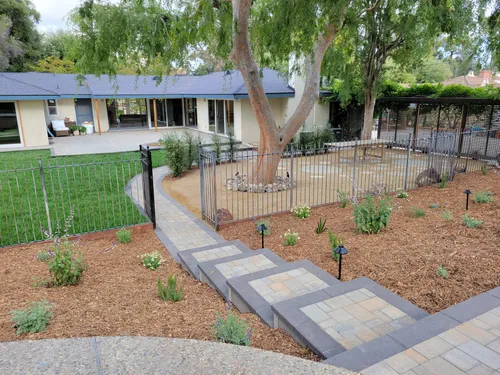
Droughtscape is a landscaping and outdoor construction company based in Los Angeles, CA. With over 45 years of experience, they specialize in drought and fire-resistant landscape design and installation, hardscaping, irrigation, fencing, artificial turf, and more. Their services cover a wide range of outdoor improvements including interlocking pavers, decks, pergolas, retaining walls, and yard drainage. Droughtscape serves multiple neighborhoods in the Los Angeles area, focusing on water-saving and sustainable landscaping solutions that suit various home styles. They emphasize clear communication and quality craftsmanship to provide a smooth project experience.
Greenplace Inc
2151 Pacific Ave A205, Costa Mesa, CA 92627
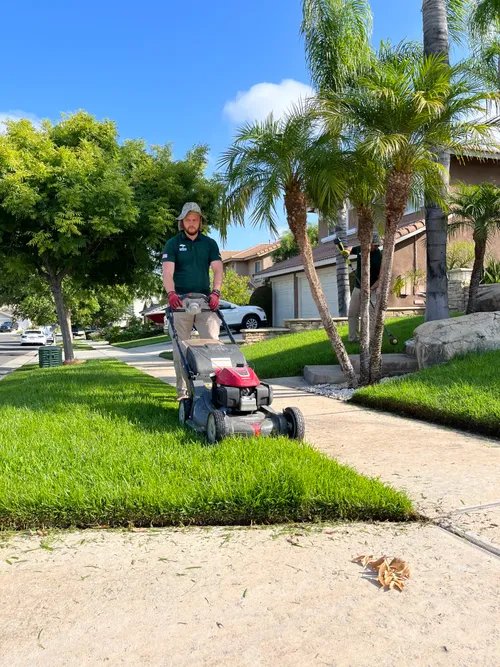
Greenplace Inc is a landscaping company based in Santa Ana, CA, offering a wide range of services including landscape design, hardscaping, lawn care, irrigation installation and repair, artificial turf, and yard drainage solutions. They serve both residential and commercial clients throughout Southern California, including Orange County and Los Angeles. Greenplace specializes in creating custom outdoor environments that combine aesthetic appeal with practical features such as smart irrigation systems to optimize water use. Founded by Volodymyr Dragan and Viktor Peshekhonov, the company emphasizes craftsmanship and long-term vision in their work. Their licensed team is known for detailed project management and responsiveness to client needs.
Irrigation Pros
Los Angeles, CA
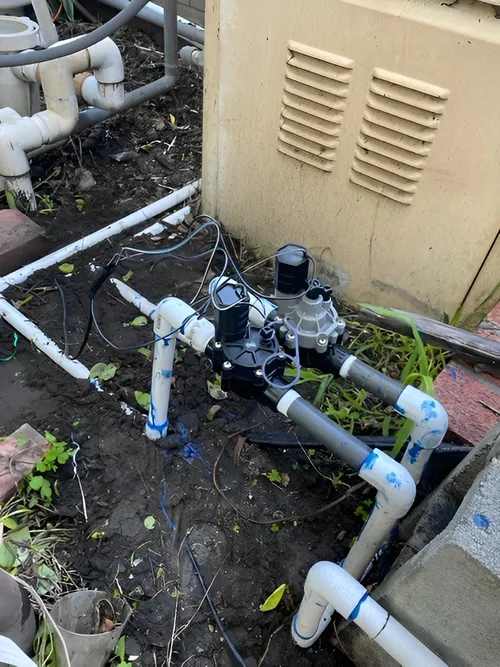
Irrigation Pros is a locally owned landscaping company serving Orange County, including Santa Ana, Irvine, Newport Beach, and Mission Viejo. They specialize in sprinkler repair, sod installation, drainage solutions, and artificial turf installation. Their services focus on efficient irrigation systems tailored to the local climate, preventing water waste and yard damage. The company offers top-grade sod and drip irrigation systems designed for sustainability and water savings. Irrigation Pros operates with years of experience in the area and provides 24/7 availability for urgent sprinkler and drainage issues.
Barba Landscape & Design
710 Marine St, Santa Monica, CA 90405
Barba Landscape & Design is a family-owned landscaping company based in Los Angeles, CA, with over 35 years of experience. They specialize in landscape design and installation, tree pruning and removal, irrigation, drainage solutions, sod and fence installation, and landscape lighting. As Santa Monica natives, they focus on creating sustainable, eco-friendly outdoor spaces that reflect the local environment. Their team offers a workmanship warranty and is fully licensed, bonded, and insured, ensuring professional standards in every project. Barba Landscape serves a broad area including Santa Monica, Pasadena, Beverly Hills, and other parts of Los Angeles and surrounding counties.
SoCal Landscape and Trees
2233 Casitas Ave, Altadena, CA 91001
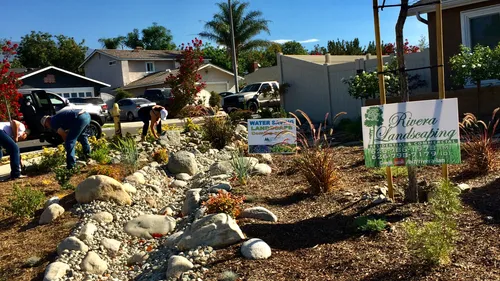
SoCal Landscape and Trees is a landscaping company based in Altadena, serving Los Angeles, CA, and nearby areas. They provide a variety of services including tree removal, lot clearing, irrigation design, hardscape design, concrete work, grading, and routine lawn care. The company emphasizes sustainable practices and community restoration, focusing on enhancing the natural beauty of local foothill neighborhoods. One of their key capabilities is custom irrigation design aimed at promoting plant health and water efficiency. SoCal Landscape and Trees is committed to each project with a personal connection to the community.
Why Proper Drainage is Critical for La Mirada Homes
Water is one of the most persistent threats to a home's structural integrity and landscape health. In La Mirada, issues can arise from seasonal rains, over-irrigation, or even the natural slope of your property. Without a proper plan, water can pool against your foundation, leading to cracks, basement or crawl space moisture, and costly repairs. Saturated soil can also kill grass, create muddy patches, and become a breeding ground for mosquitoes. Implementing effective surface and subsurface drainage is not just about fixing a wet spot; it's a preventative measure that safeguards your largest investment.
Core Principles: Grading and Drainage Systems
A comprehensive approach to water management typically starts with grading and is supplemented by specific drainage installations. Here's a breakdown of the core components.
The Foundation: Proper Yard Grading
Grading is the process of shaping the land's surface. The most fundamental rule is to ensure your yard slopes away from your home's foundation. Professionals aim for a slope of at least 5% (a 6-inch drop over 10 feet) to effectively direct surface water 1. Regrading might involve bringing in new soil, compacting existing soil, or removing earth to create the correct pitch. This is often the first and most cost-effective step in solving many water problems.
Subsurface Solutions: French Drains and Dry Wells
For water that saturates the soil, subsurface systems are key.
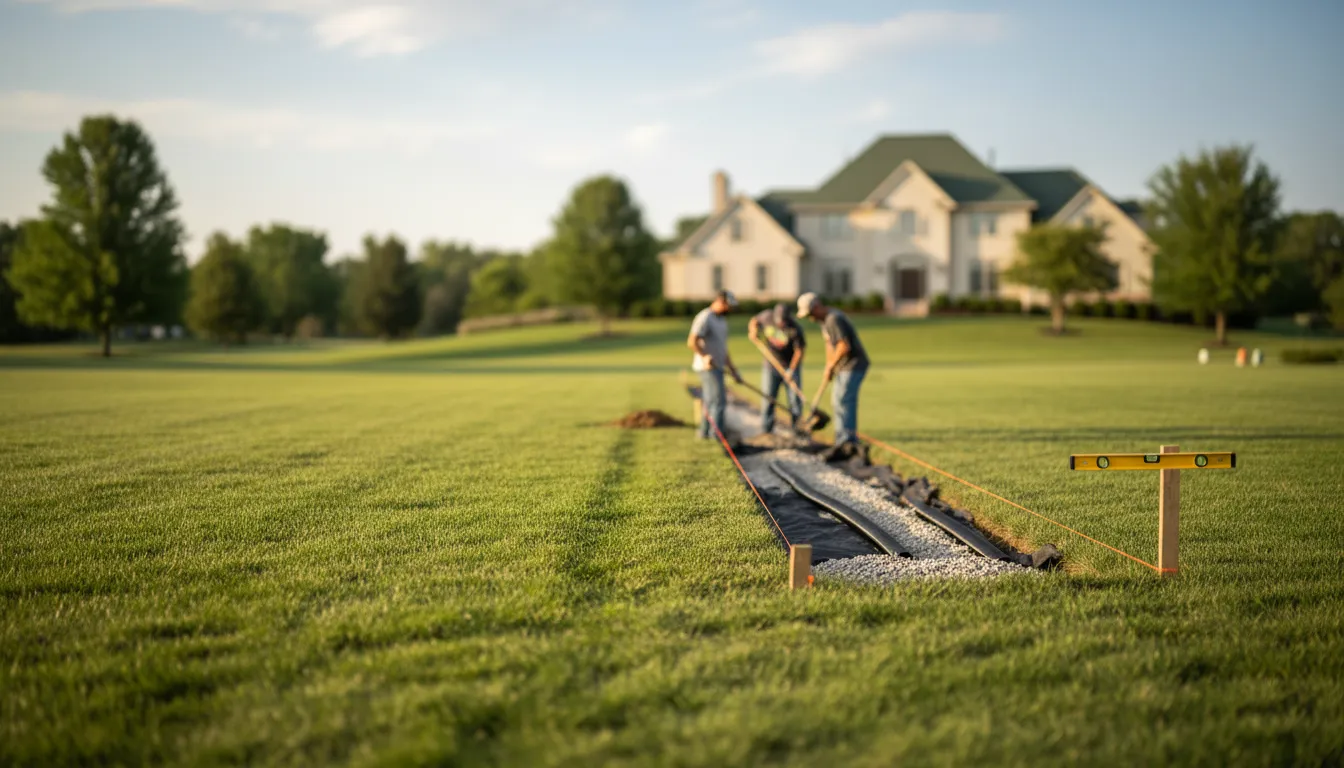
- French Drains: A perforated pipe is laid in a gravel-filled trench, often lined with landscape fabric to prevent clogging. This system collects groundwater from soggy areas and redirects it to a safer discharge point, like a street gutter or dry well.
- Dry Wells: These are underground chambers filled with gravel or a specialized crate system. They receive water from downspouts or French drains and store it, allowing it to percolate slowly back into the surrounding soil over time, which is especially useful where direct runoff isn't possible.
Surface Water Management: Channel Drains and Catch Basins
For hardscapes like driveways, patios, and walkways, surface drainage is crucial.
- Trench/Channel Drains: These are linear drains with a grate flush with the surface. Installed across driveways or in patio low points, they catch sheet flow and channel it into an underground pipe system.
- Catch Basins: These are grated boxes (typically plastic or concrete) installed at low points in the yard or hardscape. They collect a large volume of surface water, and the debris settles in the sump below the outlet pipe, which helps prevent clogs downstream. They connect to solid pipes that carry the water away.
Downspout Management
A critical, often overlooked element is handling roof runoff. Simply letting downspouts empty next to the foundation undermines all other drainage work. Solutions include long above-ground extensions or, for a cleaner look, burying solid pipes that carry roof water to a drainage system or daylight it far from the house.
The Professional Installation Process
A successful drainage or grading project follows a systematic approach:
- Assessment: A specialist will inspect your property during or after rain to identify problem areas, trace water flow, and determine suitable discharge points.
- Design: Based on the assessment, they will design a system, often combining grading with one or more drainage types (e.g., French drains feeding into a dry well).
- Permitting: The contractor should check with the City of La Mirada; larger regrading or drainage projects may require a permit.
- Excavation: Trenches are dug for pipes and basins, or the yard is sculpted for grading.
- Installation: Pipes, gravel, basins, and fabric are installed according to plan.
- Grading & Restoration: The final soil grading is completed, and all disturbed areas are backfilled, compacted, and restored with sod or seed.
- Testing: The system should be tested with water to ensure proper flow before project completion.
Find the perfect yard drainage contractors for your needs
Get personalized recommendations and expert advice
Understanding Investment and Value
The cost for drainage and grading work in La Mirada varies significantly based on the property's size, slope, and the complexity of the solution needed. Here's a general overview based on common project scopes:
- Grading: Minor fixes may start around $500, while significant reshaping of a yard can cost $2,000 or more.
- French Drain: Typically ranges from $10 to $50 per linear foot, depending on depth and materials.
- Trench/Channel Drain: Installation can cost between $30 and $100+ per linear foot.
- Catch Basins: A standard plastic unit starts around $200-$500+, while larger concrete basins can range from $2,000 to $5,000.
- Dry Well: A single unit often falls between $1,600 and $4,800+.
A simple downspout extension and regrading project might be under $1,000, whereas a comprehensive solution involving multiple drainage systems for an entire property can easily reach $15,000 or more 2 3. While an investment, effective water management protects your home's foundation and landscape, ultimately preserving property value and preventing far more expensive repairs.
Choosing the Right Solution for Your Property
Not every yard needs every type of drain. The right solution depends on your specific issue:
- Constant Soggy Lawn or Standing Water: This indicates a high water table or poor percolation. A French drain system is often the best remedy.
- Water Pooling on a Driveway or Patio: Surface water on hardscapes calls for a trench drain or strategically placed catch basins.
- Water Collecting Against the House Foundation: This is a priority issue. The solution almost always begins with regrading to create positive slope away from the house, supplemented by downspout management and possibly a French drain at the foundation's base.
- Nowhere to Discharge Water: If your property is low-lying with no downhill outlet, a dry well system may be the only viable option to collect and disperse water on-site.
Consulting with an experienced professional is the best way to diagnose the problem and design an effective, long-lasting solution tailored to La Mirada's conditions.
Frequently asked questions
Sources
Footnotes
-
13 Ways to Keep Your Yard Dry, and a Guide to Choosing the Right ... - https://blog.landscapedrains.com/types-of-yard-drains ↩
-
Landscape Grading and Drainage Costs - https://www.whiteshovel.com/blog/landscape-grading-and-drainage-costs ↩
-
Residential Drainage Solutions: Top 10 Effective Systems in 2024 - https://www.marchipaving.com/residential-drainage-solutions/ ↩