Find the Best Yard Drainage Contractors for Your Business
No obligation • Fast responses • Nationwide coverage

Why you can trust Landscape Atlas
Landscape Atlas is a leading United States resource for evaluating landscaping, lawn care, and outdoor service providers. Our team researches each category in depth, focusing on service quality, safety, and customer experience. Listings and rankings are based on independent criteria and user feedback, and companies cannot pay to influence our assessments or recommendations.
Search providers near you
Top Yard Drainage Contractors in Rancho Cucamonga, California Ranked
Effective yard drainage and grading are essential for protecting your Rancho Cucamonga home from water damage, preventing soil erosion, and maintaining a healthy, usable outdoor space. Proper water management directs runoff away from your foundation, eliminates soggy spots that can kill grass and attract pests, and helps you comply with local guidelines. This guide explains the common drainage solutions for local properties, from simple grading to complex underground systems, so you can understand your options and connect with qualified professionals who can assess your specific needs.
Artisan Landscape Construction
Santa Ana, CA
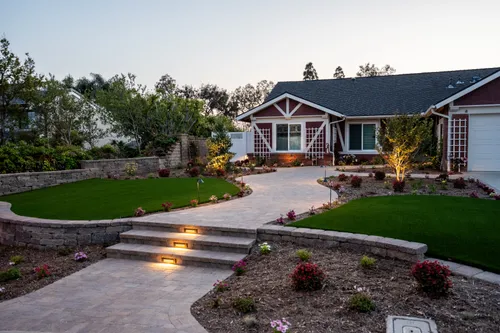
Artisan Landscape Construction is a landscape contractor based in Santa Ana, CA, specializing in transforming outdoor spaces through design, construction, and management. Their services include hardscape installation such as patios, walkways, retaining walls, and water features, as well as grading, drainage, tree care, irrigation, and landscape maintenance for various property types. The company emphasizes the use of construction documents and design plans to ensure precise project execution and offers multi-year agreements for ongoing landscape and tree services.
Ariel Builders Landscape Specialist
Anaheim, CA
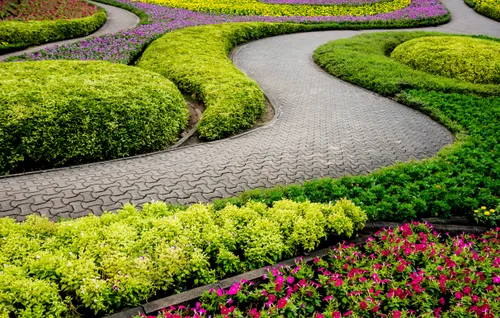
Ariel Builders Landscape Specialist offers comprehensive landscaping and remodeling services in Anaheim, CA. They focus on energy-efficient outdoor projects including drought-tolerant landscaping, artificial turf installation, and innovative design layouts featuring greenery, trees, and plants. Their services also include landscape lighting, hardscaping with pavers and stone, yard drainage solutions, and irrigation system installation and repair to maintain lawns and shrubbery. Ariel Builders Landscape Specialist integrates walkways, retaining walls, and decorative elements to enhance outdoor spaces.
Natural Earth Sustainable Landscape & Design
1420 N Claremont Blvd #200-C, Claremont, CA 91711
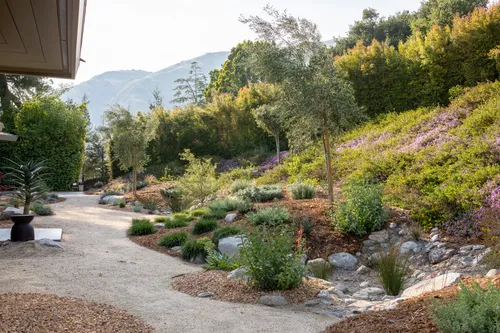
Natural Earth Sustainable Landscape & Design is a landscaping company based in Los Angeles, CA. They provide comprehensive services including landscape design, construction, and maintenance with a focus on sustainability and native Southern California plants. Their expertise includes hardscaping, naturalized drainage solutions, and irrigation systems, creating eco-friendly and low-maintenance outdoor spaces that blend form and function. Their approach is based on permaculture principles to ensure long-lasting, beautiful landscapes.
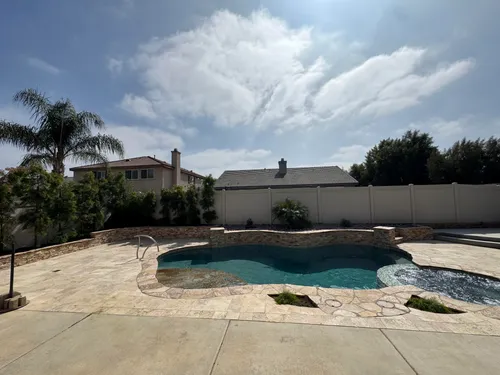
Greenwood hardscape
Riverside, CA
Greenwood Hardscape is a landscaping and hardscaping contractor based in Riverside, CA. They specialize in yard drainage, grading, pavers, retaining walls, and site preparation, combining modern innovation with timeless design to create personalized outdoor spaces. The company serves multiple locations across Southern California, including Moreno Valley, Temecula, and Corona. Greenwood Hardscape emphasizes craftsmanship and integrity in every project, offering services such as excavation and turf installation to enhance both the beauty and functionality of properties.
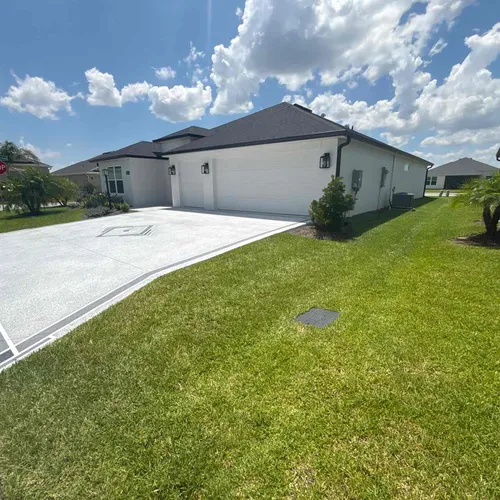
LawnStarter Lawn Care Service
4580 Belford Way, Riverside, CA 92507
LawnStarter Lawn Care Service provides a wide range of lawn care and landscaping services in Riverside, CA. Their offerings include lawn mowing, fertilization, weed control, tree removal, stump grinding, yard drainage, sprinkler installation and repair, and general landscaping. They emphasize convenience with online booking and account management, backed by insured professionals. LawnStarter also offers specialized services such as gutter cleaning and yard cleanup. The company serves various neighborhoods within Riverside and supports customers with a mobile app for easy service management.
Why Proper Drainage is Critical in Rancho Cucamonga
The semi-arid climate of Rancho Cucamonga is characterized by periods of intense rainfall, especially during winter storms. When heavy rain falls on compacted or poorly graded soil, it can't soak in quickly enough, leading to surface runoff that pools in low spots or, worse, flows toward your home's foundation. Over time, this hydrostatic pressure and moisture can cause significant structural issues, including cracked foundations, flooded basements or crawl spaces, and damaged landscaping. Implementing the right surface drainage or subsurface drainage system is a proactive measure to safeguard your property's value and integrity.
Common Yard Drainage Problems and Signs You Need a Solution
How do you know if your property needs drainage work? Look for these telltale signs:
- Standing Water: Puddles that remain in your yard for more than 24 hours after rain.
- Soggy Lawn: Spongy, constantly wet grass or areas where grass refuses to grow.
- Soil Erosion: Gullies or washed-out areas in your landscape, especially near downspouts or slopes.
- Water in the Basement or Crawl Space: Dampness, mildew, or actual flooding in below-grade areas.
- Foundation Cracks: New or widening cracks in your home's foundation or exterior walls.
- Mosquito Infestations: Standing water is a prime breeding ground for mosquitoes.
If you notice any of these issues, a professional assessment of your property grading and drainage plan is recommended.
Core Solutions for Yard Drainage and Water Management
A range of techniques can be employed to solve water issues, often used in combination for a comprehensive solution.
1. Grading and Re-Sloping
This is often the first and most fundamental line of defense. Grading involves reshaping the soil to create a gentle slope (typically a minimum of 2% away from the foundation) that directs surface water toward a safe discharge point, such as a street gutter, storm drain, or a designated dry well or rain garden area 1 2. Proper land grading ensures water flows away from structures, preventing pooling near your home's base.
2. French Drains
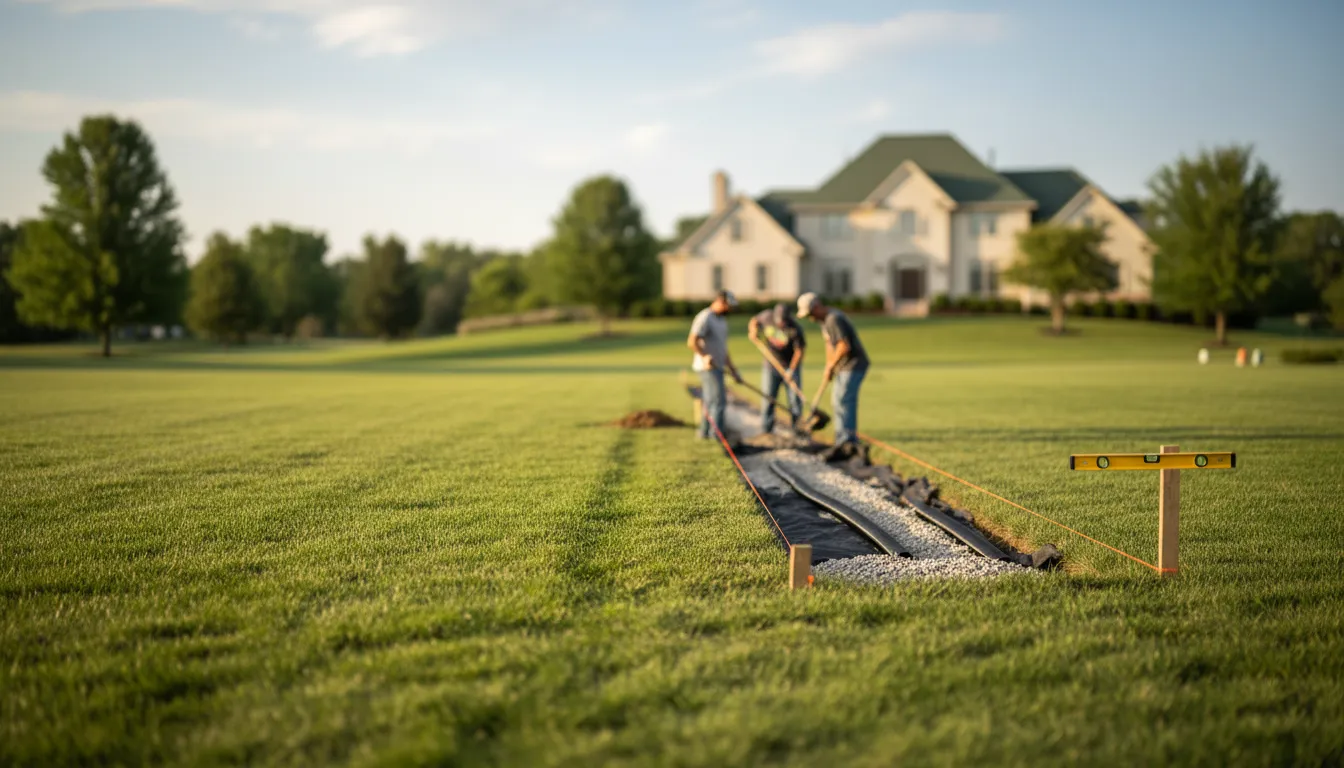
A French drain is a subsurface solution for yards with persistent soggy areas or high water tables. It consists of a trench filled with gravel and a perforated pipe wrapped in landscape fabric. The system collects excess groundwater and redirects it to a more suitable outlet. This is an excellent yard drainage solution for channeling water from low spots or the base of retaining walls.
3. Catch Basins and Channel Drains
For hardscape areas like driveways, patios, and walkways, surface water needs to be captured before it can pool. Catch basins are grated inlets connected to an underground pipe system that collect runoff from a specific area. Channel drains (or trench drains) are long, narrow grates ideal for across driveways or patio edges. Both are crucial components of a surface water drainage system for paved surfaces.
4. Downspout and Gutter Extensions
Often, a simple fix involves managing roof runoff. Redirecting downspouts with above-ground extensions or burying them with underground downspout pipes can carry roof water several feet away from the foundation and into a main drainage system or a rain barrel for collection.
5. Rainwater Harvesting and Dry Wells
In Rancho Cucamonga, capturing rainwater is encouraged for conservation. Rain barrels provide a simple method for smaller-scale collection from downspouts. For managing larger volumes of diverted water, a dry well-an underground chamber filled with gravel that allows water to percolate slowly into the surrounding soil-can be an effective discharge point, though its suitability depends on local soil conditions.
Find the perfect yard drainage contractors for your needs
Get personalized recommendations and expert advice
The Professional Drainage Installation Process
A successful drainage project follows a logical sequence to ensure long-term effectiveness.
- Site Assessment: A professional will inspect your property to identify all problem areas, evaluate soil composition, determine natural water flow, and locate legal discharge points and utility lines.
- System Design: Based on the assessment, a plan is created. This may include a site grading plan, the layout for French drains or catch basins, pipe sizing, and specifying all materials.
- Permitting: For substantial regrading or connecting to municipal storm systems, a permit from the City of Rancho Cucamonga may be required. Professionals familiar with local codes can handle this process 3.
- Installation: This involves excavation for trenches and basins, installation of pipes, fabric, and structures, backfilling with gravel and soil, and final grading and compaction of the surface.
- Testing and Final Inspection: The system is tested with water to verify proper flow and discharge, and the site is cleaned up.
Understanding Costs for Drainage Work
Investment in yard drainage solutions varies widely based on the complexity of the problem and the solutions chosen. Costs are influenced by materials (pipe, gravel, basins), labor, soil conditions, and the scale of excavation.
- Grading/Re-sloping: Often represents a lower-cost option, as it primarily involves labor and soil movement.
- French Drains: A common solution, with costs typically calculated per linear foot for materials and installation.
- Catch Basins & Structures: Prices vary significantly based on material (plastic vs. concrete) and size, with concrete basins used for higher volume applications representing a larger investment 4.
- Additional Factors: The need for a sump pump, depth of excavation, and local labor rates will all impact the final project cost.
For an accurate estimate tailored to your Rancho Cucamonga property, obtaining detailed quotes from local drainage contractors is essential.
Local Considerations for Rancho Cucamonga Homeowners
When planning a drainage improvement project, it's important to consider local guidelines. The City of Rancho Cucamonga provides resources on managing stormwater and may have specific requirements for discharging water or implementing rainwater collecting systems. Furthermore, the soil composition in different parts of the city can affect water absorption rates and the best choice of drainage technique. Consulting with a local professional ensures your system is both effective and compliant.
Frequently asked questions
Sources
Footnotes
-
12 Residential Backyard Drainage Solutions - Protect Your Yard - https://wilsonslawncare.com/12-residential-backyard-drainage-solutions/2024/ ↩
-
Site Grading Plan Solutions for Drainage Dilemmas 2025 - https://landarch1.com/site-grading-plan-solutions-for-drainage/ ↩
-
Preliminary Drainage Study, Preliminary Water Quality ... - https://sbclafco.org/wp-content/uploads/sites/60/Proposals/3255_env/appendix_f.pdf ↩
-
City of Rancho Cucamonga - https://www.cityofrc.us/sites/default/files/2020-10/Guidelines%20for%20Residential%20Graywater%20and%20Rainwater%20Collecting%20Systems.pdf ↩