Find the Best Yard Drainage Contractors for Your Business
No obligation • Fast responses • Nationwide coverage

Why you can trust Landscape Atlas
Landscape Atlas is a leading United States resource for evaluating landscaping, lawn care, and outdoor service providers. Our team researches each category in depth, focusing on service quality, safety, and customer experience. Listings and rankings are based on independent criteria and user feedback, and companies cannot pay to influence our assessments or recommendations.
Search providers near you
Top Yard Drainage Contractors in Santa Monica, California Ranked
Proper yard drainage and land grading are essential for protecting your Santa Monica property from water damage, soil erosion, and costly foundation repairs. In a city that values sustainable water management, effective drainage solutions do more than just move water-they help capture and reuse precious rainfall, aligning with local environmental goals. This guide will help you understand the common water management challenges in our area and the professional solutions available to keep your landscape healthy and your home safe.
Droughtscape
Angeles Crest Hwy, La Cañada Flintridge, CA 91011
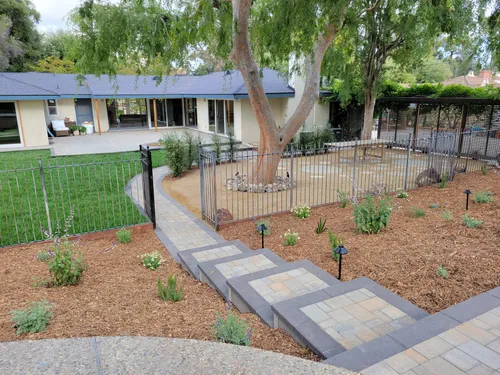
Droughtscape is a landscaping and outdoor construction company based in Los Angeles, CA. With over 45 years of experience, they specialize in drought and fire-resistant landscape design and installation, hardscaping, irrigation, fencing, artificial turf, and more. Their services cover a wide range of outdoor improvements including interlocking pavers, decks, pergolas, retaining walls, and yard drainage. Droughtscape serves multiple neighborhoods in the Los Angeles area, focusing on water-saving and sustainable landscaping solutions that suit various home styles. They emphasize clear communication and quality craftsmanship to provide a smooth project experience.
GreenView Direct
7727 calle maria, Winnetka, CA 91306
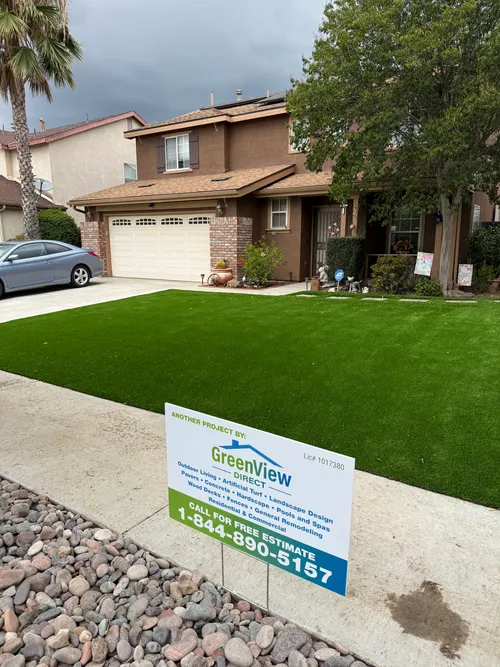
GreenView Direct is a landscaping and hardscaping contractor based in Los Angeles, CA. They offer a wide range of services including artificial turf installation, landscape design, yard drainage and grading, paver and concrete work, patios, decks, and outdoor living features such as pergolas and pool/spa design. Their team uses quality materials like natural stone and EP Henry products to create customized outdoor spaces that enhance residential properties. GreenView Direct also specializes in drainage solutions and retaining walls to manage erosion and water flow effectively. The company emphasizes a hands-on approach from design through construction to ensure client satisfaction.
Barba Landscape & Design
710 Marine St, Santa Monica, CA 90405
Barba Landscape & Design is a family-owned landscaping company based in Los Angeles, CA, with over 35 years of experience. They specialize in landscape design and installation, tree pruning and removal, irrigation, drainage solutions, sod and fence installation, and landscape lighting. As Santa Monica natives, they focus on creating sustainable, eco-friendly outdoor spaces that reflect the local environment. Their team offers a workmanship warranty and is fully licensed, bonded, and insured, ensuring professional standards in every project. Barba Landscape serves a broad area including Santa Monica, Pasadena, Beverly Hills, and other parts of Los Angeles and surrounding counties.
SoCal Landscape and Trees
2233 Casitas Ave, Altadena, CA 91001
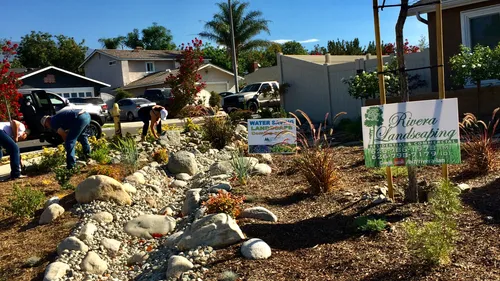
SoCal Landscape and Trees is a landscaping company based in Altadena, serving Los Angeles, CA, and nearby areas. They provide a variety of services including tree removal, lot clearing, irrigation design, hardscape design, concrete work, grading, and routine lawn care. The company emphasizes sustainable practices and community restoration, focusing on enhancing the natural beauty of local foothill neighborhoods. One of their key capabilities is custom irrigation design aimed at promoting plant health and water efficiency. SoCal Landscape and Trees is committed to each project with a personal connection to the community.
Coastline Pavers
Santa Ana, CA
Coastline Pavers is a licensed and insured landscaping and hardscaping company based in Santa Ana, CA. They specialize in designing and building custom outdoor living spaces, including sod and artificial turf installation, fence installation, landscape lighting, yard drainage solutions, land clearing, and hardscaping such as pavers and retaining walls. The company offers 2D and 3D design services to help clients visualize their projects and uses high-quality materials from trusted suppliers. Coastline Pavers is CCPI certified and emphasizes a balance of quality workmanship and competitive pricing. Their experienced team manages projects from initial design through installation and warranty follow-up, ensuring comprehensive service.
Understanding Drainage Problems in Santa Monica
Santa Monica's unique coastal climate and urban landscape create specific drainage challenges. Many homes deal with standing water, soggy lawns, or water pooling against foundations after a rainstorm. These issues are often caused by compacted soil, improper initial grading, or hardscapes like driveways and patios that direct water toward the house instead of away from it. Addressing these problems is not just about comfort; it's critical for preventing mold, wood rot, and structural issues that can be incredibly expensive to fix.
The city encourages Low Impact Development (LID) principles, which focus on managing stormwater runoff sustainably. This means local solutions often go beyond simply piping water to the street. Instead, the goal is to slow down, spread out, and soak in rainwater on your property, reducing the burden on municipal systems and improving groundwater recharge.
Core Solutions: Grading and Surface Drainage
The first line of defense against water problems is ensuring your yard is properly graded. Land grading involves sculpting the soil to create a gentle slope, typically 2-5% away from your home's foundation, to guide surface runoff toward a safe discharge point 1 2. This is a fundamental step that many other drainage systems rely on to function correctly.
For minor issues, slope correction might be all that's needed. This process involves adding or removing soil to reshape the land. For more significant pooling, swales-shallow, grassy channels-can be installed to direct water flow across your property. Another effective surface solution is replacing impermeable surfaces with permeable paving. Materials like permeable pavers, gravel, or porous concrete allow water to seep through into the ground below, drastically reducing runoff from patios, walkways, and driveways.
Subsurface and Capture-Based Drainage Systems
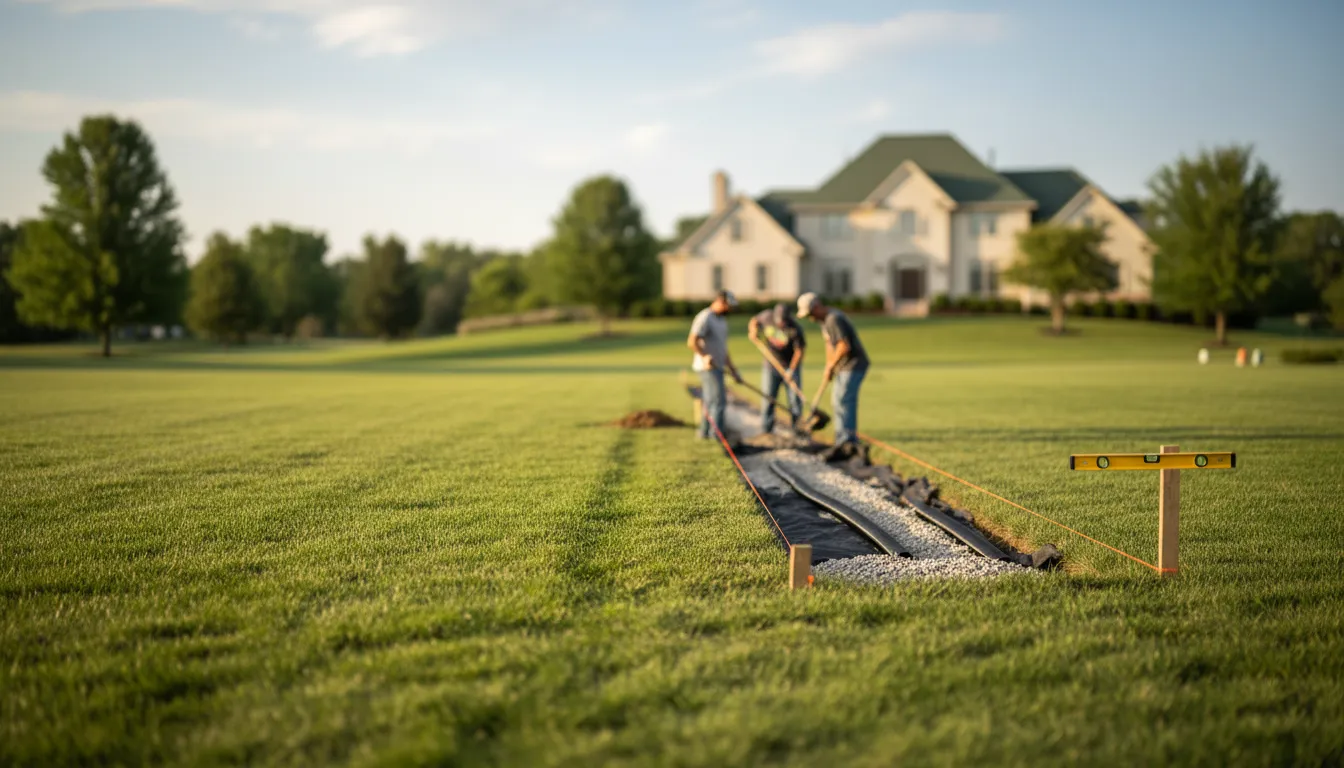
When surface grading isn't enough, or water is coming from underground sources, subsurface systems are required. The most common of these is the French drain. This involves digging a trench, laying a perforated pipe surrounded by gravel, and covering it with soil and sod. It acts like an underground river, collecting excess water from saturated soil and channeling it safely away.
For managing larger volumes of water from downspouts or paved areas, a dry well is an excellent solution. This is an underground pit filled with gravel or a specialized chamber that collects stormwater and allows it to slowly infiltrate into the surrounding soil over time 3. It's a crucial component for properties with heavy clay soil that drains poorly.
Santa Monica homeowners are also increasingly turning to systems that capture and reuse water. Rain barrels or larger cisterns connected to your downspouts collect roof runoff, which can then be used for irrigating your garden during dry periods. This simple step reduces your water bill and the overall volume of runoff from your property.
Find the perfect yard drainage contractors for your needs
Get personalized recommendations and expert advice
Sustainable Landscaping for Drainage: Rain Gardens and Bioswales
One of the most beautiful and ecologically sound drainage solutions is the incorporation of rain gardens or bioswales. These are strategically placed, shallow depressions planted with deep-rooted native plants and grasses. They are designed to capture runoff from roofs, driveways, and other hard surfaces, allowing the water to pool temporarily and then slowly filter into the ground.
Beyond solving drainage issues, these features create vibrant habitat for pollinators, add visual interest to your landscape, and naturally filter pollutants from the water before it reaches the groundwater. They are a perfect example of how functional yard water management can enhance your property's beauty and environmental value.
The Professional Process: From Assessment to Restoration
A successful drainage project follows a clear sequence. It begins with a thorough site assessment, where a specialist identifies problem areas, evaluates soil type (like its percolation rate), and considers local rainfall patterns.
Next comes the design phase, which plans the specific slopes, drain locations, and system components while ensuring the project complies with Santa Monica's urban runoff requirements 4. For larger projects involving significant earthmoving or new structures, a city permit may be required.
The construction phase involves excavation and grading to shape the land, followed by the installation of pipes, basins, or other system parts. Finally, landscape restoration puts the finishing touches on the project, which may include laying new sod, planting a rain garden, or installing permeable surfaces to blend the new system seamlessly into your yard.
Understanding Project Costs in Santa Monica
Costs for drainage and grading work in Santa Monica vary widely based on the solution's complexity, materials, and labor. Here's a general overview of what you might expect:
- Rain Barrels: A DIY-friendly option typically ranging from $100 to $400 for setup.
- Simple Grading/Slope Correction: Addressing minor issues can cost between $500 and $2,000.
- French Drain: Often priced per linear foot, ranging from $10 to $100 depending on depth and complexity 5.
- Dry Well: Unit costs for installation generally fall between $1,000 and $4,800 6.
- Rain Garden/Bioswale: A complete installation including design, plants, and labor can range from $800 to over $3,000 7 8.
- Permeable Paving: Material and installation costs are typically between $5 and $20 per square foot 9.
Given the variables, it's highly recommended to get detailed quotes from several local specialists who understand Santa Monica's specific codes and conditions.
Frequently asked questions
Sources
Footnotes
-
Grading Yard for Drainage: A Homeowner's Step-by-Step Guide - https://tamuradesigns.com/grading-yard-for-drainage/ ↩
-
How Land Grading Helps with Yard Drainage - Dirt Connections - https://www.dirtconnections.com/how-land-grading-helps-with-yard-drainage/ ↩
-
Control Heavy Runoff - Solving Drainage and Erosion Problems - https://www.fairfaxcounty.gov/soil-water-conservation/drainage-problem-control-runoff ↩
-
How to Comply With Urban Runoff Requirements - https://www.santamonica.gov/process-explainers/how-to-comply-with-urban-runoff-requirements ↩
-
12 Residential Backyard Drainage Solutions - Protect Your Yard - https://wilsonslawncare.com/12-residential-backyard-drainage-solutions/2024/ ↩
-
Landscape Grading and Drainage Costs - https://www.whiteshovel.com/blog/landscape-grading-and-drainage-costs ↩
-
City of Santa Monica Urban Watershed Management Program - https://www.waterboards.ca.gov/water_issues/programs/climate/docs/resources/sm_2005runoffbrochure.pdf ↩
-
What You Can Do to Soak Up the Rain | US EPA - https://www.epa.gov/soakuptherain/what-you-can-do-soak-rain ↩
-
Green Infrastructure for Los Angeles: - https://www.waterboards.ca.gov/water_issues/programs/climate/docs/resources/la_green_infrastructure.pdf ↩