Find the Best Yard Drainage Contractors for Your Business
No obligation • Fast responses • Nationwide coverage

Why you can trust Landscape Atlas
Landscape Atlas is a leading United States resource for evaluating landscaping, lawn care, and outdoor service providers. Our team researches each category in depth, focusing on service quality, safety, and customer experience. Listings and rankings are based on independent criteria and user feedback, and companies cannot pay to influence our assessments or recommendations.
Search providers near you
Top Yard Drainage Contractors in Keller, Texas Ranked
Proper yard drainage and grading are essential for protecting your Keller home from water damage. When rainwater pools around your foundation or saturates your lawn, it can lead to costly structural issues, basement flooding, and a ruined landscape. Effective water management solutions, like grading the soil to slope away from your house or installing subsurface drains, control the flow of stormwater to keep your property dry and stable. This guide will help you understand the common drainage problems in our area and the professional solutions available to resolve them, so you can connect with local experts who can assess and fix your yard's specific needs.

Casas Irrigation Drainage & More
110A Rose Ln Suite 204, Frisco, TX 75036
Casas Irrigation Drainage & More provides drainage, irrigation, and landscape lighting services in Dallas, TX. They offer sprinkler installation, repair, and maintenance, along with grading and yard drainage solutions tailored to local environmental needs. Their expertise includes fixing broken sprinkler heads, underground leaks, low water pressure, and uneven coverage to maintain healthy lawns and efficient water use. The company serves the Dallas area with a focus on customized outdoor lighting and irrigation systems designed to enhance both function and appearance.
Magnolia Turf Co. Dallas
3200 Garden Brook Dr, Farmers Branch, TX 75234
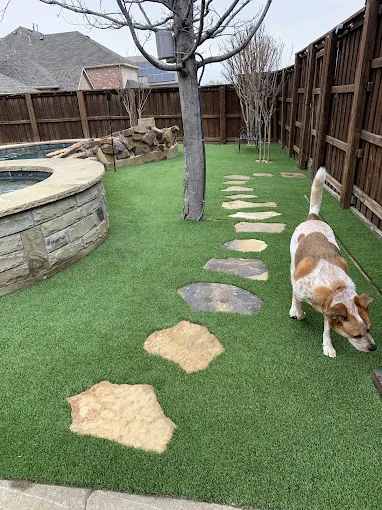
Magnolia Turf Co. Dallas provides artificial grass installation and yard drainage services in Dallas, TX. They specialize in installing premium artificial turf designed to withstand the Texas heat and offer durable, low-maintenance lawn solutions. Their projects often include grading and drainage improvements to enhance yard functionality and safety. With over 10 years of experience and more than 10,000 installations, Magnolia Turf Co. Dallas serves both residential and commercial clients, delivering turf that maintains color and resilience under intense sunlight.
Bird's Landscape and Irrigation LLC
Fort Worth, TX
Bird's Landscape and Irrigation LLC is based in Fort Worth, TX, providing a range of landscaping and irrigation services. They specialize in irrigation and drainage system design and installation, including gravity propelled and sump pump powered water management. The company also offers sod installation, landscape lighting, hardscaping, and sprinkler system services for both residential and commercial properties. With over 24 years of experience, Bird's Landscape and Irrigation delivers expert solutions focused on improving yard appearance and home curb appeal.
Lux Texas Sprinkler Repair and Drainage
5000 Eldorado Pkwy #150, Frisco, TX 75033
Lux Texas Sprinkler Repair and Drainage is a landscaping and irrigation company based in Dallas, TX. They provide sprinkler repair, drainage solutions, and landscaping services for both residential and commercial properties. The company specializes in yard drainage and irrigation system installation and repair, helping to maintain healthy outdoor spaces and protect home foundations. Founded in 2018, Lux Texas Landscaping serves the North Dallas and Fort Worth areas with licensed professionals focused on eco-friendly and innovative landscaping solutions.
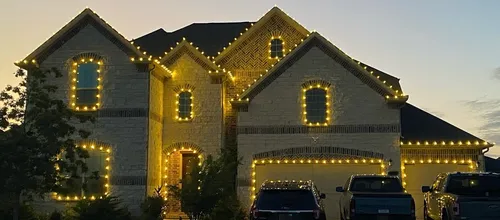
Landscape Legends & Holiday Lighting
Fort Worth, TX
Landscape Legends & Holiday Lighting is a landscaping and lawn care company based in Fort Worth, TX. They provide a wide range of services including lawn mowing, weed control, fertilization, shrub and tree trimming, landscape lighting installation, hardscaping, irrigation system installation and repair, and seasonal clean-ups. The company is known for personalized service and eco-friendly practices, tailoring projects to the unique needs of each client. They have been serving the area for over five years and also offer holiday lighting installation.
Why Drainage is Critical for Keller Homes
Keller's weather patterns, with periods of intense rainfall, can quickly overwhelm a poorly drained yard. The region's common clay soil compounds the problem, as it absorbs water slowly and leads to prolonged surface pooling and runoff. Without a proper slope or drainage system, this water has nowhere to go but toward your home's foundation. Over time, this hydrostatic pressure can cause foundation cracks, invite moisture into crawl spaces, and create a breeding ground for mosquitoes. Investing in professional drainage and grading isn't just about lawn care; it's a fundamental step in home maintenance that preserves your property's value and integrity.
Common Yard Drainage Problems in North Texas
Identifying the symptom is the first step toward a cure. Here are frequent signs of drainage issues you might notice in your Keller yard:
- Standing Water: Puddles that remain for hours or days after a rainstorm, often in low-lying areas of the lawn or near the foundation.
- Soil Erosion: Washouts or gullies forming in your landscape, especially near downspouts or on sloped areas, where fast-moving water carries away topsoil.
- Soggy Lawn: Areas of grass that are constantly spongy, promote moss or fungus growth, or are too wet to mow.
- Water in the Basement or Crawl Space: The most serious sign, indicating water is penetrating the foundation walls or slab.
- Overflowing Gutters: Gutters that dump water directly next to the foundation because downspouts are too short, clogged, or improperly directed.
Core Solutions: Grading and Drainage Systems
Professional water management employs a combination of techniques tailored to your property's layout. The goal is always to capture, channel, and safely disperse water away from critical areas.
Regrading Your Landscape
Grading is the process of shaping the soil to create a consistent slope. For effective foundation protection, the ground should slope away from your house at a minimum grade of 5% (about a 6-inch drop over 10 feet) 1. Regrading may involve bringing in new soil, compacting existing soil, and smoothing the surface to ensure gravity works in your favor. This is often the first and most impactful correction for surface water problems.
Subsurface Drainage: French Drains and Dry Wells
When water is moving underground or saturating the soil, surface grading isn't enough. This is where subsurface systems come in.
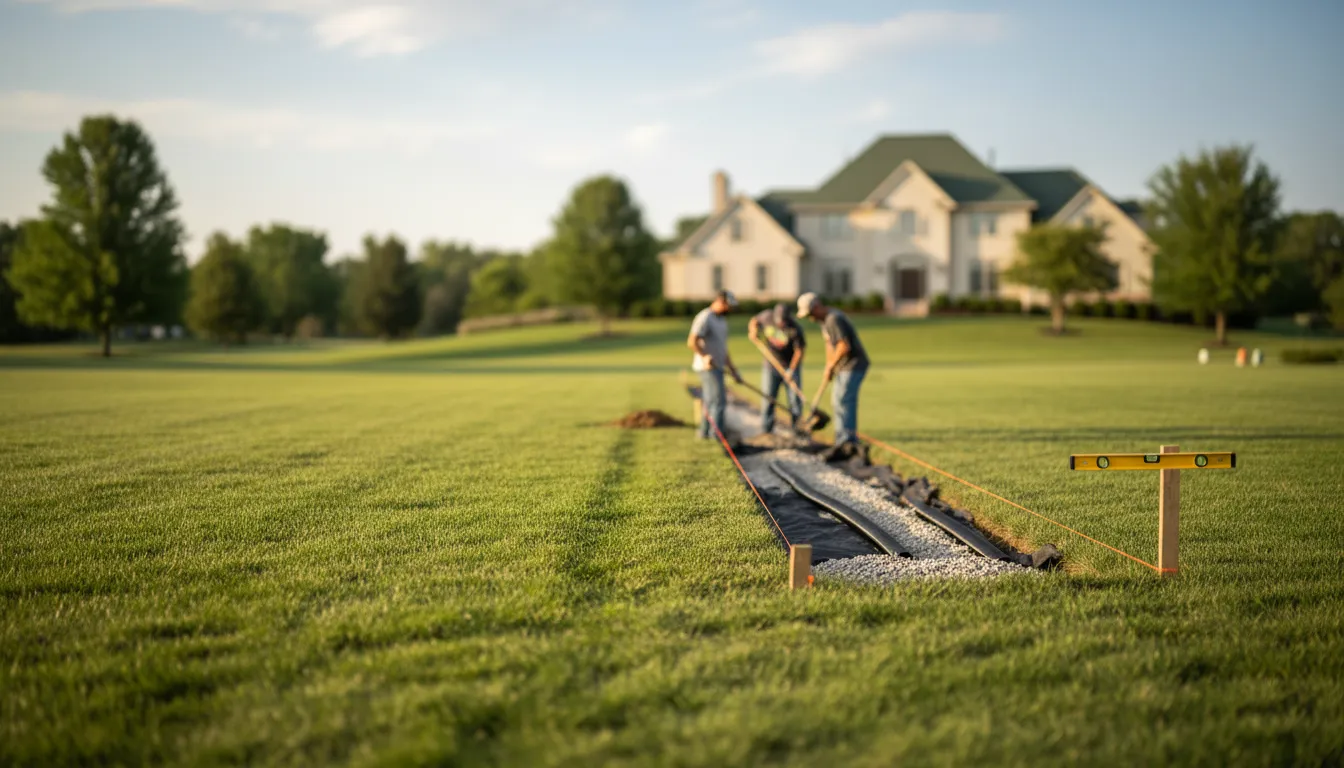
- French Drains: A trench is dug, typically along a problematic area or the foundation's perimeter. A perforated pipe is laid in the trench, surrounded by gravel and wrapped in filter fabric to prevent clogging. This system collects groundwater and redirects it to a safer discharge point, like a storm drain or a dry well 2.
- Dry Wells: An underground pit filled with gravel acts as a holding tank for collected rainwater, allowing it to slowly percolate into the surrounding soil over time. They are often used as the termination point for French drain pipes or downspout extensions.
Surface Water Management
For water that runs across the surface, different tactics are used:
- Channel Drains: These are narrow, grated drains installed across driveways, walkways, or patio edges where water collects. They connect to solid piping that carries the water away 3.
- Swales: These are broad, shallow ditches, often grass-lined, designed to gently channel runoff across your property. They can be landscaped to look like a natural part of the yard while performing a crucial function 4.
- Downspout Management: Simply extending your downspouts 5 to 10 feet away from the house can be a highly effective and low-cost improvement. For larger volumes, downspouts can be connected to underground pipes that lead to a drainage system 5.
Eco-Friendly Absorption: Rain Gardens
A rain garden is a landscaped depression planted with native, water-tolerant plants. It's designed to capture runoff from roofs or paved areas, hold it temporarily, and allow it to filter into the ground naturally. This solution reduces the burden on drainage systems, filters pollutants, and adds beautiful, low-maintenance landscaping to your yard 6.
Find the perfect yard drainage contractors for your needs
Get personalized recommendations and expert advice
The Professional Drainage Project Process
Understanding the steps a professional will take can help you know what to expect.
- Site Assessment and Diagnosis: A specialist will inspect your property, ideally during or after a rain, to identify all water sources, flow paths, and problem areas. They will check soil type and evaluate the existing slope.
- Design and Planning: Based on the assessment, they will design a customized solution. This plan may combine several methods (e.g., regrading with a French drain leading to a dry well) and will account for local Keller regulations 7 8.
- Preparation: The work area is marked, and utilities are located (call 811 before you dig). Any necessary permits are secured.
- Excavation and Installation: This is the physical work: reshaping soil for grading, digging trenches for pipes, or excavating for dry wells and rain gardens 9.
- System Installation: Pipes are laid, drains are set, gravel and filter fabric are placed, and all components are connected.
- Finishing: The area is backfilled with soil, sod is replaced or seed is sown, and any final landscaping (like planting a rain garden) is completed 10.
Understanding Investment and Cost Factors
The cost for drainage and grading work in Keller varies widely based on the complexity of the problem and the solutions required. Here's a general range:
- Minor Corrections: Fixing a clogged drain, adding downspout extensions, or a small regrading project might range from a few hundred to $1,000 11.
- Standard System Installation: Installing a French drain for one problem area, a channel drain, or a modest rain garden typically falls in the $1,000 to $3,000+ range.
- Comprehensive Solutions: A whole-yard drainage system involving extensive regrading, multiple French drains, swales, and dry wells can cost between $4,000 and $8,000+ 12.
- Large or Complex Projects: For properties with significant slope challenges, very poor soil, or large acreage, systems can exceed $10,000 13.
Key factors influencing cost include the size of your yard, the severity of the slope issue, the type of soil (Keller's clay is more challenging to work with), the amount of existing landscaping that needs to be worked around or restored, and any local permit fees.
Maintaining Your Drainage System
Once installed, a well-designed system requires minimal maintenance, but a few simple steps will ensure it lasts for decades:
- Keep Gutters and Grates Clear: Regularly remove leaves, twigs, and debris from gutter downspouts and the grates of any surface drains.
- Inspect After Heavy Rains: Walk your property after a storm to ensure water is flowing correctly and there is no new pooling.
- Avoid Compaction: Don't drive or park heavy equipment over areas where subsurface drains are buried.
- Manage Plant Growth: For French drains and dry wells, ensure tree and shrub roots do not invade the pipes or gravel beds.
Frequently asked questions
Sources
Footnotes
-
Grading Yard for Drainage: A Homeowner's Step-by-Step Guide - https://tamuradesigns.com/grading-yard-for-drainage/ ↩
-
Best Drainage Systems To Deal with Stormwater - This Old House - https://www.thisoldhouse.com/driveways/best-drainage-systems-to-deal-with-storm-water ↩
-
12 Residential Backyard Drainage Solutions - Protect Your Yard - https://wilsonslawncare.com/12-residential-backyard-drainage-solutions/2024/ ↩
-
Swales, Drains, and Site Grading for Stormwater Control - https://basc.pnnl.gov/resource-guides/swales-drains-and-site-grading-stormwater-control ↩
-
Simple Steps to Manage Stormwater in Your Backyard - JP Operations - https://www.jpoperations.com/blog/simple-steps-to-manage-stormwater-in-your-backyard ↩
-
Water Management In The Home Landscape - Clemson HGIC - https://hgic.clemson.edu/factsheet/water-management-in-the-home-landscape/ ↩
-
Keller Foundation Repair & Drainage Systems - https://straightlinefoundationrepair.com/service-area/keller/ ↩
-
Stormwater Management Program | City of Keller, TX - https://www.cityofkeller.com/services/public-works/environmental-services/stormwater-quality ↩
-
Yard Drainage Improvement Services in Keller, TX - https://kellerdrainage.com/get-yard-drainage-improvement ↩
-
Making Your Yard RainReady - https://rainready.org/sites/default/files/factsheets/Factsheet-RainReady-Yard_0.pdf ↩
-
Rainwater Management - A Guide for Homeowners - https://nr.tulaliptribes.com/Content/documents/Rainwater-Management.pdf ↩
-
Get Stormwater Drainage Installation in Keller, TX - https://kellerdrainage.com/get-stormwater-drainage-installation ↩
-
Cost of Yard Drainage Installation in Keller, TX - https://kellerdrainage.com/cost-of/yard-drainage-installation ↩